

I bought the 36 pack of Stingmon sticky traps in May 2025, and I want to be straight with you about why. Not because I had read something clever. Because I had fungus gnats coming out of six pots I had just repotted, and I was annoyed enough to spend money on the least attractive solution in the aisle.
Eighteen months later, about half the pack is still in my kitchen junk drawer, two cards are out in pots at any given time, and I have a fair amount to say. Some of it is good. Some of it is the kind of thing I wish somebody had told me before I peeled the first backing off, because I stuck that first card to my own sleeve within about ninety seconds.
The Quick Verdict
They catch adult gnats, they do not fix the soil, and they are the ugliest thing in my living room. I still keep two out.
Amazon Check Today's Price →The 36 pack I am still working through 18 months later
Two cards at a time, swapped about every four weeks. That is the whole method. If you have gnats coming off freshly repotted plants, this is the cheap half of the fix.
Amazon Check Today's Price on Amazon →How I Ended Up Buying Them
The gnats showed up in April 2025. I had spent the last weekend in March repotting six plants, and I used both 6 quart bags of the 2 pack over that Saturday and Sunday. The fig went into its 12 inch glazed pot. I watered everything until it ran out the bottom, because fresh soil in a bigger pot looks dry on top when it is not dry underneath. That is the whole origin story. My mistake, not the bag's.
By the third week of April I could see them on the kitchen sill every time I moved a pot. Small dark flies lifting off the soil, not many at once, but steady. That is the stage where you can talk yourself into ignoring it for another month, and I did for about two weeks.
Before the Stingmon cards I tried a soil drench from the garden center. No brand worth naming, one bottle, mixed in the watering can. The gnats eased off for about three weeks and then came back, and I have not used a drench since. I did not like the idea of pouring something through my pots again and again, and I did not like that it only bought me three weeks.
So I went looking for something that would sit there and work without me mixing anything. That is what a sticky trap is. It is not a treatment. It is a census with a body count.
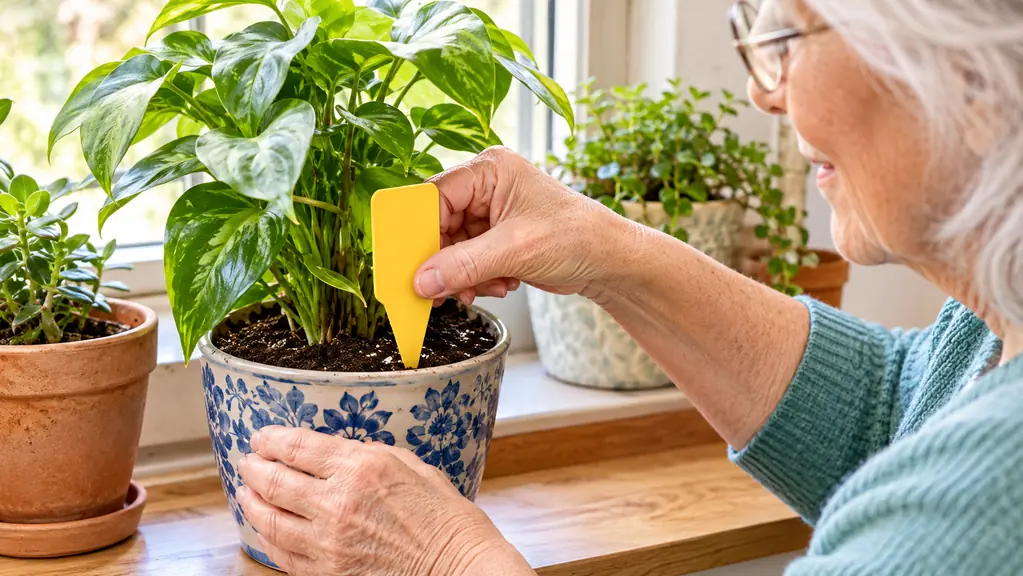
What the Cards Actually Are
A flat plastic card, listed at 3.15 inches wide and 5.2 inches tall, with glue on it. The Stingmon pack is 36 of them, dual-sided, item weight just over an ounce for the whole thing, which tells you how thin they are. The bottom is pointed and sharp enough to push straight into soil. That is the entire product. There is no power source. Nothing to plug in, nothing to replace, nothing to remember.
I laid one on the kitchen counter next to a ruler to check the size before I trusted it in a pot. Three and a quarter inches across the top, a little over five inches tall, and about as thick as the side of a cereal box. The pointed end went into a dry pot of mix with a push from my thumb. In the fig's pot, which is denser and has roots near the edge, I had to wiggle it a little and the top bent slightly before it sprang back. It did not break. I would not make a habit of bending them, but one did survive me being impatient.
The listing says the bright color attracts flying insects and the glue keeps them from escaping, and it names the targets: fungus gnats, whiteflies, blackflies, thrips, fruit flies, midges, mosquitoes and other flying insects. I can only vouch for fungus gnats, because that is what I had. I have never had whiteflies and I hope to keep it that way.
One thing the listing mentions that I want to underline, because it is buried in a warm prompt: in summer heat the glue can soften. I keep my house at 70 in the summer and I have not had a card melt, but I also do not leave them in a hot garage or against a south window in August. If you were thinking of putting these in a greenhouse or on a sunbaked porch, that note is there for a reason.
The First Two Weeks, Honestly
I pushed 6 cards into 6 pots on a Saturday. Pushing them in is easy, though you want to go at the edge of the pot rather than straight down through the middle, because the middle is where the roots are and the card is stiff.
In about two weeks the gnats were clearly fewer. Clearly. Not gone. I want to be careful here because this is where I think people get disappointed. The cards catch the adults that are flying. They do nothing at all about the eggs and the larvae in the wet soil, and those are what keep the next generation coming.
I counted because I am that person. Eight days in, the card in the fig's pot had 19 adults stuck to it, and the card in the peace lily had 11. The pothos on the kitchen sill had 4. By day fourteen the fig card was up to 31 and I swapped it. That told me where the problem was concentrated, which I would not have known just from looking at the pots. It also told me the kitchen sill was not the source, which saved me from moving plants that did not need moving.
What actually finished the job was two things together. The cards knocked down the adults I could see, and I let the top of the soil dry out more between waterings, which is the part that hits the larvae. If I had only done the cards, I think I would have kept catching gnats all summer and called the product a failure. It is not a failure. It is half a solution, and the listing does not pretend otherwise.
In about two weeks the gnats were clearly fewer. Clearly. Not gone. The cards catch the adults that are flying, and nothing in that pack touches the eggs in the wet soil.
What Nobody Tells You Before You Buy
The cards grab things that are not gnats. My sleeve. My hair, twice. Once, a paper towel. When you reach past a plant to water the one behind it, the card does not know the difference between a gnat and the cuff of your cardigan, and it holds on with the same enthusiasm.
They are also genuinely unattractive. These are sticky rectangles standing up in your pots, and if you have spent any time arranging a living room so it looks like a person lives there rather than a greenhouse, a card in the fiddle leaf fig is a visible compromise. I put mine where the light is good and where I am not sitting and looking at them all evening.
I thought about trimming one card to fit a smaller pot and decided against it. The cut edge would leave the sticky layer open on the side, and I could picture it catching the curtain or a cat tail instead of a gnat. If a pot is too small for a full card, I would rather leave that plant out of the sticky trap plan than cut one down and make a mess.
The last thing, and this matters in my house: these have to go high or behind a closed door. Pepper is nine and she climbs, and the cards are exactly the sort of flat, grabby, interesting thing a cat investigates. Biscuit is eleven and does not climb anything, but his tail sweeps a low pot on his way past. Mine are only in pots on high shelves or on window sills, out of reach of both of them, and if you have pets that get into your plants, that is how I would do it. I would not leave one at floor level and hope.
If a pet does get at a plant or a card, that is a question for your vet, not for me, and I would not take anybody's word on the internet about it, including mine.
What I Liked
- Catches adult fungus gnats where they fly, and the count is visible
- Dual sided cards with a pointed bottom that pushes into soil
- 36 cards means two at a time lasts well over a year
- No power, no batteries, nothing to mix or spray
Where It Falls Short
- Does nothing about eggs or larvae in the soil
- Glue grabs sleeves, hair and paper towels as readily as gnats
- Visibly ugly standing up in a pot
- Glue can soften in summer heat
- 36 pack is more than a small collection needs
18 Months In: How I Use Them Now
Two cards out at any time. When a card is full, which for me is about every four weeks, I peel the backing off a fresh one, push the old one into the trash with the soil edge first so I do not touch the glue side, and set the new one in. That is a two minute job four times a month. It is the least demanding thing I own.
I do the swap on a Sunday morning after watering, because that is when I am already at the pots. I keep the spare cards flat in the junk drawer between the twist ties and a roll of tape, backing still on. If you peel the backing before you are standing at the pot, you will regret it, because the card will fold onto itself and stick to your fingers and you will throw it away. I did that once and I am still annoyed about it.
I have used maybe 18 of the 36, which is why half the pack is still in the junk drawer. If you have a serious infestation across a lot of pots, you will go through them much faster and the 36 pack will make sense as a single purchase. If you have two or three pots with a mild problem, you will be handing the rest to a neighbor.
I do not rotate them around the house on a schedule. I put them where the gnats are, and when a card stays clean for a month, I stop putting one there. That felt obvious to me and it took me a while to actually do it. There is no reason to keep a trap in a pot that has no bugs in it.
Where They Fit Among the Other Things I Bought
I want to be clear about the order I did things in, because I did not buy all of this at once and I do not want to give the impression that a sticky card is the whole answer to indoor plant problems.
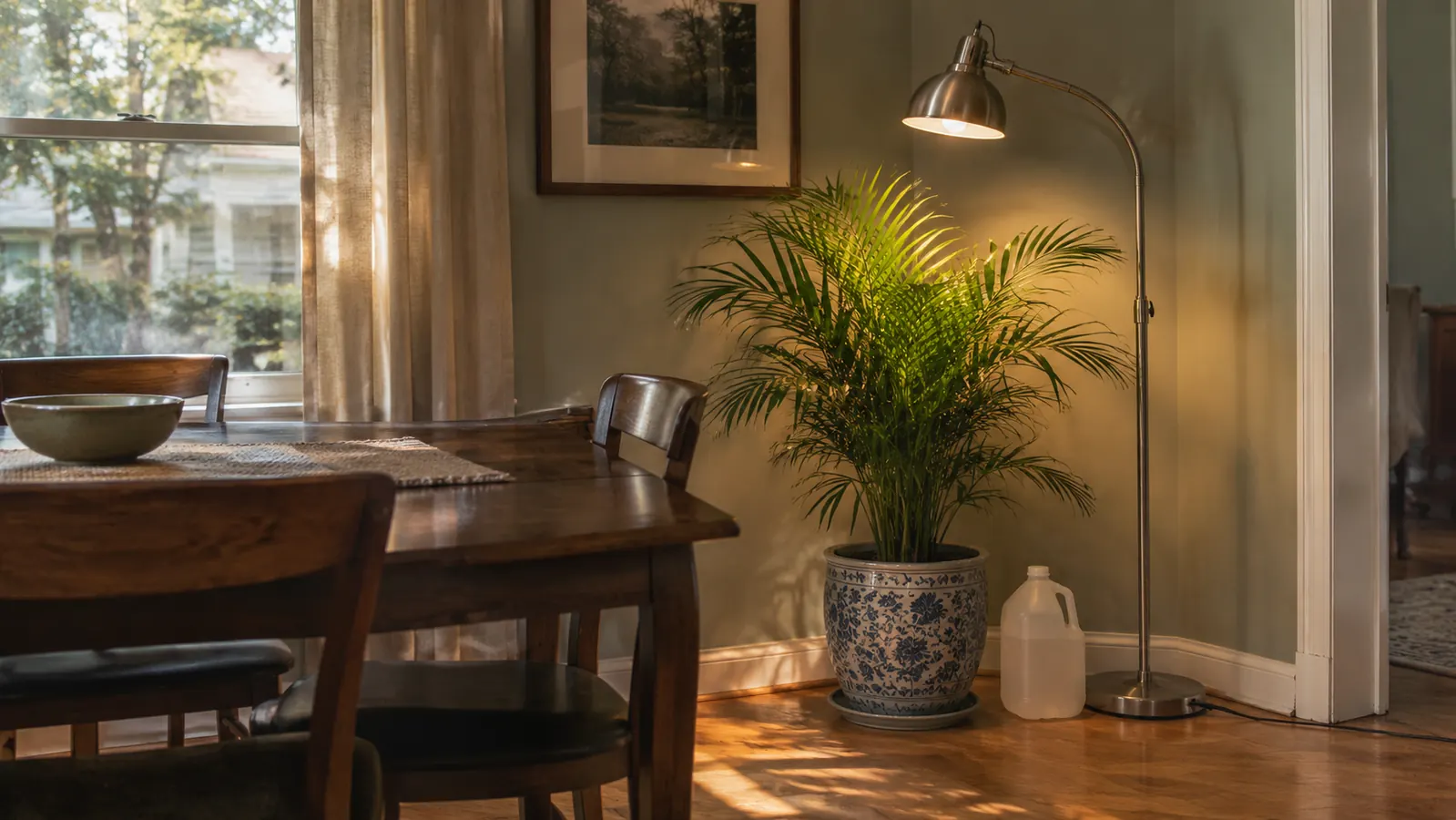
The potting mix came first, back in March 2025, and it is also where the gnats partly came from in the sense that fresh moist soil plus my overwatering equals gnats. The Stingmon cards came in May. The wood caddy came in August when my back went out dragging the fig to vacuum. The floor lamp came in October for the dim dining room corner. The watering stakes came in January 2026 to get ready for Tucson.
Those things solve different problems. The cards are about a bug. The caddy is about a heavy pot. The lamp is about a dark corner. The stakes are about being away for twelve days. None of them overlap, and I would be suspicious of any article that told you one of them fixed the rest.
The one place the cards and the stakes touch is this: the three pots that have watering stakes in them year round are the Boston fern, the peace lily and the parlor palm. I do not put sticky cards in those, because I cannot see the soil surface with a stake and a hose in the way, and I would rather keep the two systems in separate pots.
If you are down to catching the adults one at a time
36 dual sided cards, pointed ends, no power, nothing to mix. Push one into the soil at the edge of the pot and leave it. Two weeks tells you whether you have a real problem.
Amazon See the 36 pack on Amazon →How I've Tested Them
There is no instrument here. This is a woman with 24 houseplants in a one story ranch in Rochester, Minnesota, checking cards once a week. But the record is specific enough to be useful, so here it is.
May 2025 through about July 2025: six pots, six cards, a real infestation in freshly repotted soil. Gnats clearly reduced in two weeks, resolved in roughly six weeks once I also cut back the watering. From August 2025 to now: two cards at a time, swapped every four weeks, mostly catching a handful of adults as a standing check rather than fighting anything.
I changed two things at once in that first stretch, the cards and the watering, and I cannot separate them cleanly. If you want a fair test, put out a card, leave your watering exactly as it is for two weeks, and see what the card tells you. Then decide about the soil. I did it the other way around because I was impatient, which is my usual method.
Two absences in that window. Twelve days in Tucson in February 2026 and nine days in Maine in September 2026. Both times I left two cards in the high shelf pots and came home to no gnat problem in either. I cannot tell you the cards did that by themselves, because the plants were also on a lighter watering schedule while I was gone and Deb looked in once. But nothing got worse, and that is all I ask.
Who This Is For
This is for you if you have fungus gnats you can see, you have pots you can get a card into, and you want something that starts working without you mixing, spraying, or remembering a schedule. It suits a house with a handful of plants on sills and shelves. It suits someone who is willing to also let the soil dry out more, because that is the other half and the cards will not do it for you.
It also suits anyone who wants to know whether they have a bug problem at all. A clean card after three weeks is real information. I have used it that way more than once.
Who Should Skip It
Skip it if your pots are too small or too crowded to take a card, if the plants are in a hot spot where the glue could soften, or if you cannot put them out of reach of pets and small children. Skip it if you are looking for something that gets rid of gnats in the soil, because this does not and cannot. A card in a 4 inch pot will also make a top heavy plant tip if somebody bumps the shelf, and I would not bother in pots that small.
And skip the 36 pack specifically if you have one or two pots. It is a lot of cards. I am 18 months in and still working through mine. A smaller count would have been the sensible purchase for my house, and I only do not regret it because I know exactly where the spares are.
The honest summary after a year and a half: Stingmon sticky traps do one job and do it well, they are ugly, they grab your sleeve, and they are not a cure. I keep buying nothing else because I still have half a pack. When it runs out, I will buy them again. That is about as clear a verdict as I can give you.
Half a pack left, and I would buy it again
If you have gnats in the pots and you want the adults off your plants this week, this is the cheapest thing I know that actually shows you results. Pair it with drier soil and you are most of the way there.
Amazon Check Today's Price on Amazon →