The week before Gene and I left for Tucson, I counted the plants and did not like the number. Twenty four pots, twelve days away, and a neighbor who is kind but not a plant person. I had tried this before. In October 2024 I pushed two plain terracotta spikes into wine bottles, left for ten days, and came home to a dead Boston fern. So in January 2026 I bought the Blumat Classic stakes, the 3 pack without the adapter, and put them in the three plants that fold fastest when nobody is watching.
I have now used them for ten months and two trips. This is not a piece about how clever they are. It is what I noticed, in the order I noticed it, including the morning I found a peace lily limp because a hose had slipped out of a jug. I am not a gadget person. I want the plant alive when I open the door.
The Quick Verdict
Slow, silent and boringly reliable for a week or two away, as long as you tape the hose to the jug and can live with three water jugs on the floor.
Amazon Check Today's Price →Three plants, twelve days, and the jugs were a third down
The 3 pack without the adapter is the one I bought in January and the one still sitting in my pots. Current price and the listing details are on Amazon.
Amazon Check Today's Price on Amazon →How I've Used It
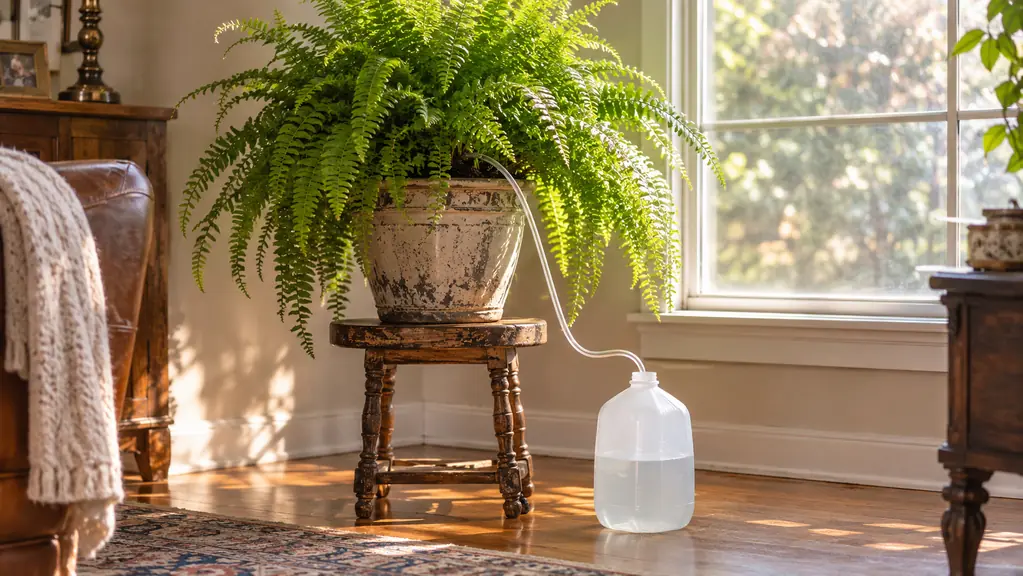
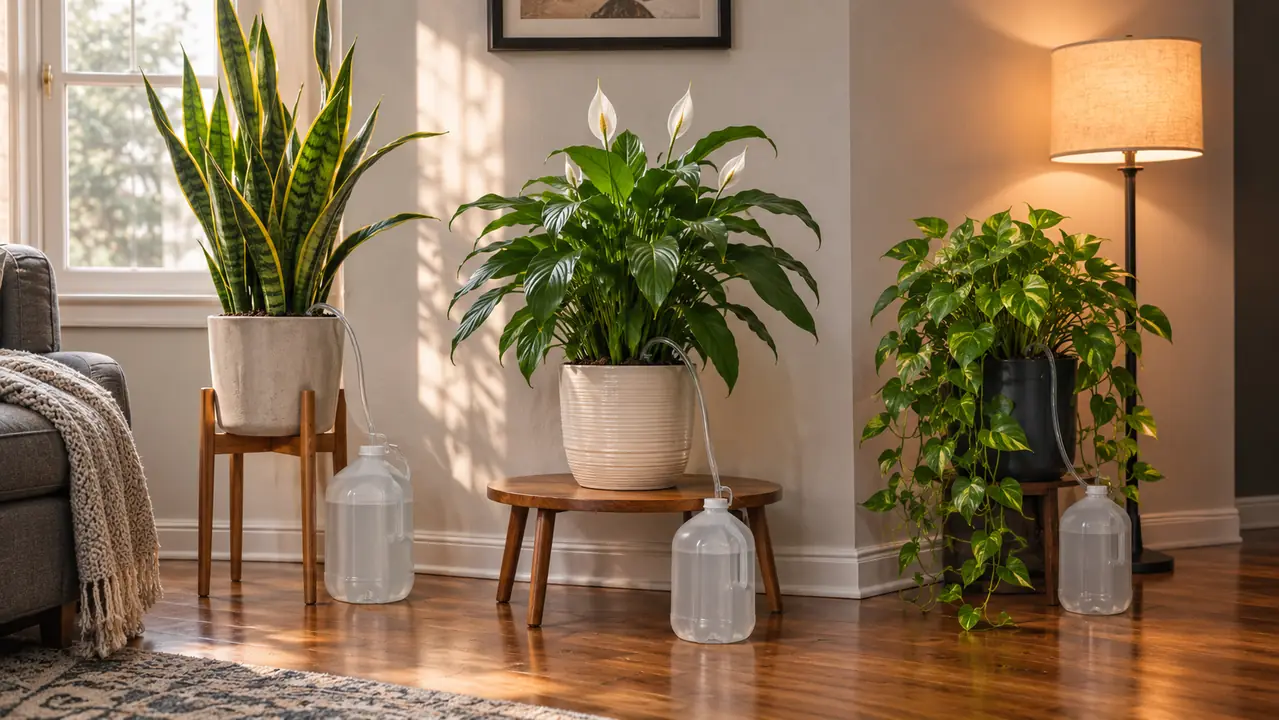
I bought the Blumat stakes in January 2026, a 3 pack, the version without the adapter. Three stakes went into three plants. The Boston fern in the living room, on the old fixed wooden stand that used to hold the fig. The peace lily beside it by the south window. The parlor palm in the dining room corner, the dim one, which only lives because of the floor lamp I bought in October.
The fig did not get one. It is about six feet tall in a 12 inch glazed pot and it drinks differently from a fern, and I was not going to learn a new thing on the plant I care most about. The other twenty one plants got a good Sunday watering before we left and nothing else.
Each stake has its own one gallon jug beside its pot, with the 38 inch hose running from the jug into the soil. That is the whole setup. For the rest, follow the directions in the box, because I am not going to rewrite them and get them wrong for you. I ran a one week test at home in January before we left, and that test earned its keep. The hose slipped out of the peace lily's jug and the plant was limp by the fifth morning. I now tape every hose to its jug with a strip of tape. It takes about a minute.
I did that test in the second week of January, five days at home with the furnace running the way it runs in Rochester in January, which is a different test from a warm house in June. I filled all three jugs to the top on a Sunday morning, marked the level with a pencil line on the plastic, and then did nothing for five days. By the fifth morning the fern's jug had dropped about an inch. The palm's had barely moved. The peace lily had dropped the most and was also the plant that was limp, because its hose had come off somewhere around day three and the soil had gone dry from there. The other two never wilted. That told me something useful: the failure is at the jug, not in the cone, so the fix was at the jug.
Then we went to Tucson for twelve days in February. All three plants were fine when we walked in. The jugs were about a third down. Nine days in Maine in September, the same. Deb looked in once on the pets and glanced at the plants, and that is all I ask of her now.
Packing for Tucson took me an afternoon and the stakes took about ten minutes of it. I filled the three jugs in the kitchen sink, because a gallon jug is easier to carry full from the sink than from the garage, carried them one at a time, set them down, pressed each hose on hard, taped it, and then stood there for a minute looking at the three of them on the floor. Gene asked if that was it. It was. The reason I remember the afternoon is that I also unplugged the floor lamp and moved the parlor palm about a foot closer to it before we left, which turned out not to matter, and I spent more time worrying about that than about the stakes.
What the Stakes Actually Do
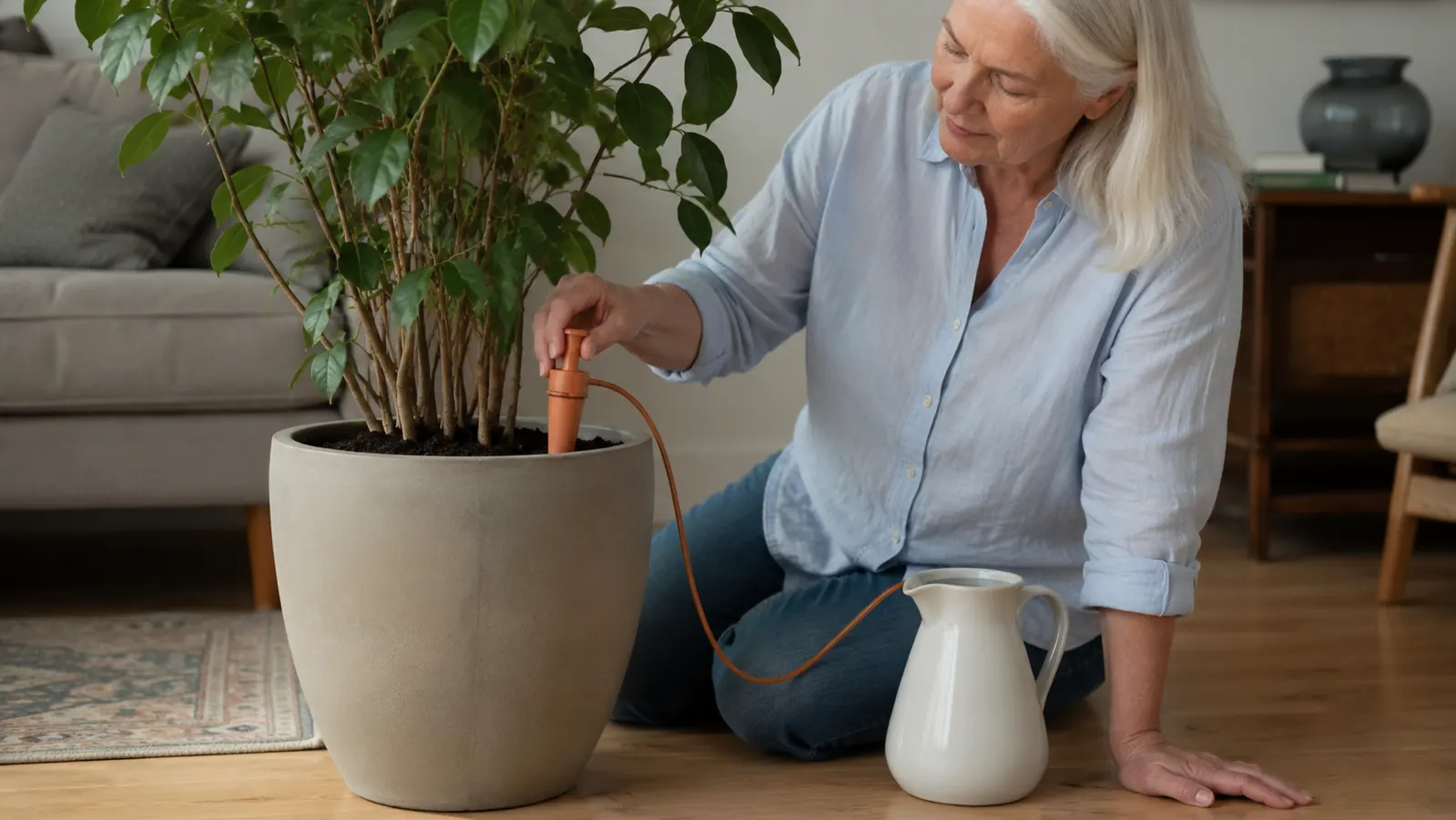
Here it is without the sales language. A clay cone goes in the soil. A hose runs to a jug. Water comes out of the jug as the soil around the cone dries. The listing calls it automatic watering and air powered, and there is no cord, no battery and no timer anywhere on it. It weighs 1.6 ounces and measures 5 by 2 by 1 inches. It is a small object doing a small job.
That last part matters more to me at sixty seven than it would have at forty. My grow light has a timer. The stove has a clock I still cannot set. These stakes have nothing to program, nothing to reset after the power blinks, and nothing that beeps. They are silent. Gene watches the news in the next room and does not know they are there. There is also nothing about them to fail quietly in a way I would not notice, which is more than I can say for the timer on the lamp, which I have found switched off twice after an outage without knowing how long it had been off.
The honest limit is that it does not water on a schedule. It responds to the soil it sits in. In a cool week in February the jug barely moved. In a warm week with the furnace running it went down faster. Once you accept that, you stop expecting it to be a sprinkler system and start treating it as a slow sip.
The listing says the lines can be shortened for a tighter setup or extended longer if you want, which is a thing I have not needed, because the 38 inch hose is more than enough for a jug sitting on the floor beside an 11 or 12 inch pot. I mention it because if your pots are on a high shelf you will care about that more than I do, and you should read the listing rather than take my word for a situation I have not been in. Mine are all at floor or table height, all three hoses slack, none stretched.
Twelve days in Tucson, nine in Maine, and the jugs were about a third down both times. I have not lost a plant on a trip since.
What Ten Months Looked Like
They have not come out of those three pots since January. I put them in for a trip and left them in, which is what the listing suggests and what made sense anyway. The fern is still on the stand. The palm is still in the corner under the lamp. The peace lily is still by the window. Nothing has been re-potted around them and nothing has jammed.
What I noticed is smaller than a before and after. On the Sundays I was a day late, nothing was limp. The peace lily is the honest one in my collection. It droops when it is dry and it tells you within hours. It has not drooped between waterings since the stakes went in, and before that it drooped most months.
The palm in the dining room corner is the one I have watched most closely, because that corner was a dead corner for years and the palm is the first thing that ever lived in it. It came home the same week as the floor lamp in October 2025 and put out its first new frond about eight weeks in, right around Christmas. Through this whole stretch it has had a stake in the pot and a jug on the floor and it has not browned a tip. I am not going to tell you the stake grew it. The lamp grew it. The stake kept it from drying out on the two occasions I was not there to water it, and one of those was twelve days long.
The jugs are the measure of it. Twelve days and about a third gone from each. That is slow. For a trip it is exactly right, and it means I came home to water still in reserve rather than three dry pots. For a big thirsty plant in July it would not be enough, which is the other reason the fig does not have one. I have thought about buying a second set for the fig and I have not, because a six foot fig in a 12 inch pot drinks a great deal in July and one gallon would be a guess I do not want to make with that plant.
How It Compares to the Spikes I Tried Before
October 2024, two plain terracotta spikes pushed into wine bottles, one in the fern and one in the peace lily. We were gone ten days. The bottles emptied in about four days and the fern was dead when we got home. That fern is the reason I bought the current one in spring 2025. The bottles and spikes went in the bin that week.
The difference I can actually put my finger on is the pace. The wine bottle had one opening and no control over it, so it dumped everything it had and then sat empty for six days. The Blumat stakes put water in slowly enough that the pot has time to use it, and the jug was still two thirds full on the twelfth day rather than dry on the fourth. I do not know why that is true mechanically and I am not going to pretend I do. I know what my fern did.
I cannot explain the science of why one emptied in four days and the other three sat a third full after twelve. What I can tell you is that I stopped trusting the wine bottle trick and I have not had a reason to stop trusting these. The listing shows 4.2 out of 5 from a little over five thousand reviews, which is not a perfect score, and a perfect score would make me suspicious anyway.
Where It Annoyed Me
The jugs are on the floor. There is no way around it. Three one gallon jugs beside three pots is not a look, and in a small living room you will feel them. One now lives behind the fern stand where it is mostly out of sight. The other two I can see from the chair, and I have made peace with that.
Pepper knocked one over in the spring. She is nine and she climbs, and a jug of water on the floor is a thing to investigate. That is why the fern's jug moved behind the stand. Biscuit sheds, and his hair ends up along the baseboard where the jugs sit, so I lift them when I vacuum. There is a water ring on the hardwood under the peace lily's jug that I have not got out, and I have stopped trying. A saucer under it would have saved me that, and I have since put one down.
And the hose. The slip in January was my own fault for not pressing it on hard, but it is the one failure that costs a plant, so tape it and check it before you walk out the door. A minute of tape is cheaper than a fern. The other gripe is smaller. When the jug gets low, under about a quarter, the flow gets weak in a way that is hard to tell from the stake having done its job. If you are going to be gone more than two weeks, top the jugs off in the middle, or have someone do it.
What I Liked
- Ran twelve days in Tucson and nine in Maine with no plant lost
- No cord, no battery, no timer, nothing to reset after a power blink
- Stayed in the same three pots year round, so there is nothing to set up twice
- Water was still about two thirds there when we got home, so there was margin
- Small enough to sit in a pot without crowding the roots
Where It Falls Short
- Three one gallon jugs sit on the floor beside the pots
- A hose can slip off the jug, which happened to me in the first week
- No good for a large thirsty plant, which is why the fig never got one
- Not a schedule, so it does nothing in a cool week and more in a warm one
- Slow refills mean you still have to be home to fill the jugs before you go
Who This Is For
If you are going away for a week or two and you have a handful of plants that sulk when they dry out, this is the version I would buy first. Three pots is my limit and the 3 pack suits it. It also suits anyone who has killed a plant with the wine bottle trick and does not want to repeat it, and anyone who does not want another app, another cord or another thing with a timer on it.
It suits a slow drinker best. A fern, a peace lily, a palm, a pothos. Something that likes to stay a little damp and does not gulp. If your plant is in a warm room in July and drinks a quart a week, one jug will not carry it and you will be disappointed. The other person it suits is someone whose back has gone. I stopped dragging heavy pots around in August 2025, when the fig went onto a caddy with locking wheels, and the stakes fit the same kind of thinking. Nothing heavy to lift, nothing to move, one gallon jug at a time and no pot gets picked up.
Who Should Skip It
Skip it if you want your watering handled for a month, or if you have thirty plants and want one reservoir doing the work. Three stakes and three jugs is a small answer to a small problem. Skip it too if you cannot stand visible water containers on your floor, because there is no version of this where the jug disappears.
Skip it if what you actually need is to water less often, not to leave town. These do not fix overwatering, and they do not fix a plant in the wrong light. Mine went in after I had already sorted out light and soil, and it worked because the rest of the routine was already right. And if you have pets that get into things, keep the jugs where they cannot reach them and check any plant with your vet before you assume anything about it.
The 3 pack without the adapter is the one I bought and still use
Three stakes, three jugs, three plants, ten months. Current price and the full listing details are on Amazon.
Amazon Check Today's Price on Amazon →