
Repotting a houseplant goes wrong in the same three places every time. The new pot is too big. The roots get crammed in instead of loosened. And the plant gets watered on the same Sunday schedule it has always had, into fresh mix that did not need a drop yet. I have made all three mistakes in that exact order, in my living room, on hardwood floors, with an unopened bag of potting mix on the floor beside me.
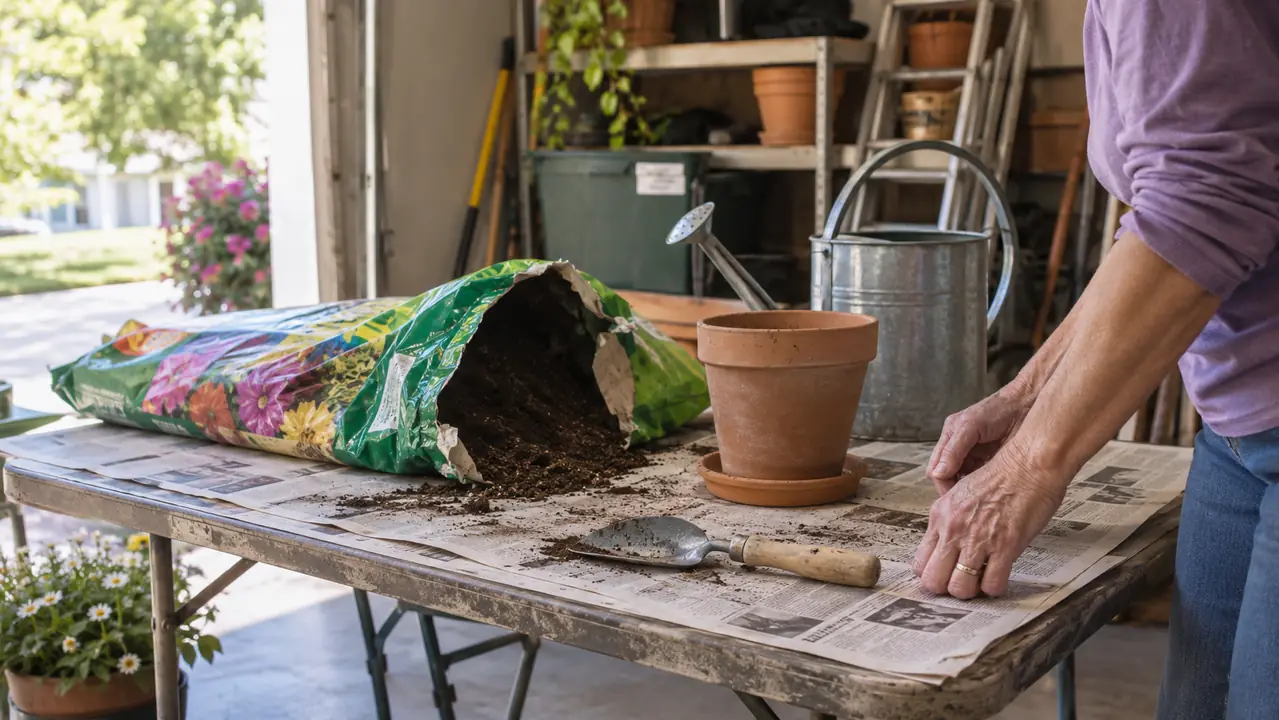
That was 2024. In March 2025 I bought Miracle-Gro Indoor Potting Mix, the 6 quart bags in a 2 pack, and I moved the whole job to the garage, onto an old card table, with the door to the house shut so Pepper and Biscuit stay inside. I am 67, retired in 2022 after 31 years working in a school office, and I keep 24 houseplants in a one story ranch in Rochester, Minnesota. My lower back is the reason the card table exists. Here is the order I work in.
The mix I buy as bags, never as a tub
Two 6 quart bags to a pack. One bag fills four 6 inch containers, which is the number I plan a repotting weekend around before I lift anything.
Amazon Check Today's Price on Amazon →Before You Open the Bag
First, decide whether the plant actually needs this. Roots coming out of the drainage hole, water running straight through the pot, a plant that tips when you nudge it, mix that has shrunk an inch below the rim, or a plant that has sat in the same pot two or three years. Those are the signals I use. A plant that is content in its pot does not thank you for moving it. I repot about six plants a year now, not twenty four, and the rest get the Sunday watering and nothing more.
Second, buy the pot before you open the bag. Go one size up, not two. The fig is six feet tall in a 12 inch glazed pot with an 11 inch base, and it is still in that pot because it has not asked for more. A pot that is too big holds water the roots never reach, and that water sits there. Root rot starts that way, and fungus gnats move in after it.
Then there is what you are repotting into. The label on the Miracle-Gro bag reads sphagnum peat moss, coconut coir, and perlite, and it says it feeds for up to 6 months. The 6 quart bag fills four 6 inch containers, which is the number I plan with. My repotting weekend in March 2025 was six plants across one Saturday and Sunday, and it used both bags in the 2 pack. I buy the bags, not a tub, and the part bag gets rolled shut with a clip and kept on a garage shelf.
Step 1: Set up where the mess can stay
Do this somewhere you can sweep. I use the garage card table with newspaper over it and the door to the house shut, because Pepper climbs and Biscuit sheds and neither one is helpful at close range. Old clothes, the new pot, a saucer, a trowel, a watering can with a narrow spout, and a pair of kitchen gloves. I lay the bag flat on the table and open it there. Opening a bag on the floor is how you end up kneeling, and kneeling is the thing I am trying to avoid.
Put the empty pot next to the plant before anything else happens, so you can see the size difference with your own eyes. If the new pot looks huge next to the old one, it is. Two inches wider is plenty. I also set the saucer under the new pot first, on the table, and slide it along as I work. That saves me lifting a full pot of wet mix afterwards, which is the worst lift of the entire job.
I write the plant's name on a strip of masking tape and stick it to the side of the new pot before the plant goes in. Two years from now, when I cannot remember which plant went into which pot, the tape tells me. It sounds fussy. It has saved me twice.
One more thing worth doing: open the bag a half hour before you start. It is not a rule, but the mix handles better in your hands when it has been open to the air a little while, and I have never once regretted giving myself the half hour.
Step 2: Get the plant out without pulling it by the stem
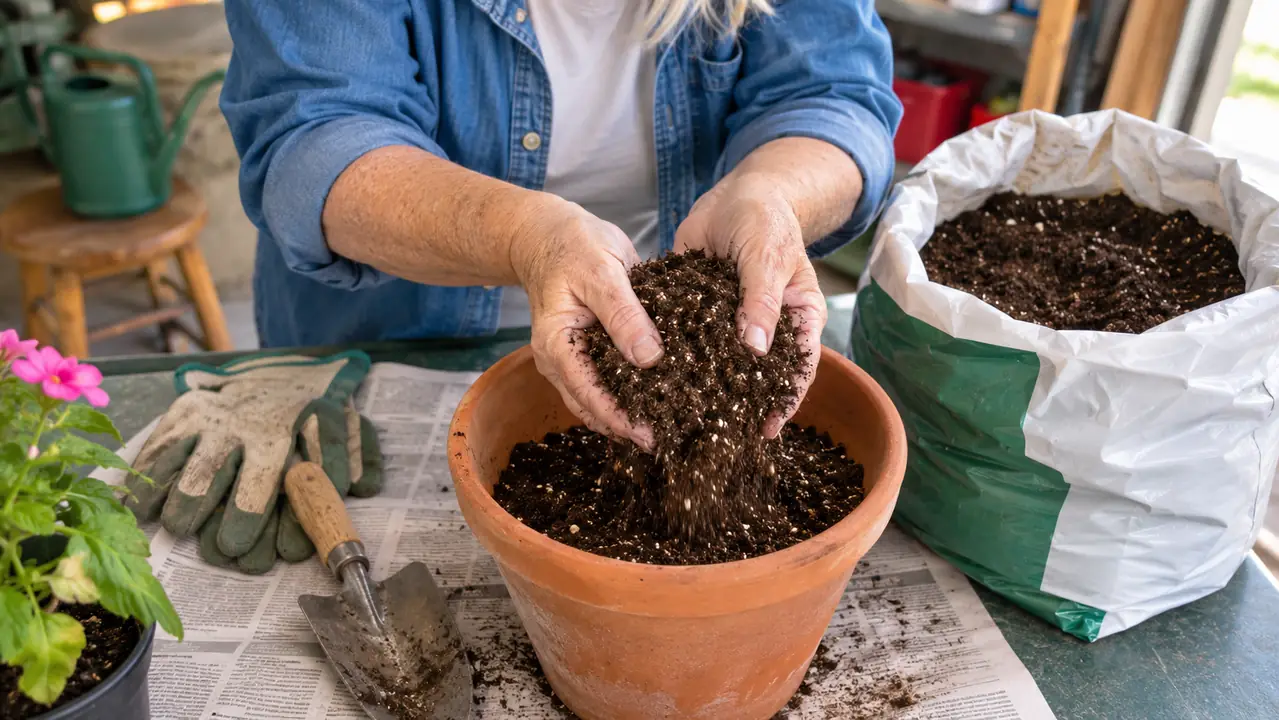
Water the plant the day before, not the morning of. Damp mix holds the root ball together. Dry mix falls away and takes half the roots with it. When you are ready, run a butter knife around the inside rim of the pot, all the way down. Then tip the pot on its side on the table, put one flat hand under the root ball, and let the pot come off rather than pulling the plant out. Never pull on the stem. The stem is not attached to anything that will hold.
Flexible nursery pots can be squeezed on all sides and the plant will slide free. A glazed pot gives you nothing to squeeze, so the knife around the rim does the work. If it still will not budge, stop. Water it, wait a day, try again. I have cracked a pot by rushing and I have broken a good root ball the same way, and both cost more than waiting until tomorrow.
The big snake plant in the living room is the one I ask Gene to lift down off its spot. He does not touch the plants otherwise, but he can lift and I cannot. The fig stays put unless I have a reason. When I do have a reason, it goes onto its caddy first, so I am rolling it and not carrying it.
Step 3: Loosen the roots and set the height
Once it is out, look at the root ball. If the roots have wound around the outside in a circle, break that circle. I use my fingers and work from the bottom, teasing the roots outward. If a coil is tight, I score it with a knife in two or three places, not deep, just enough to break the pattern. Do not wash the old soil off. It is not dirty. It is the part the plant already knows.
Now the height. The top of the root ball should sit about an inch below the rim of the new pot, so you have a lip to water into. Too high and every watering runs down the outside and onto the floor. Too low and the stem sits in wet mix. Set the root ball in, add mix under it if you need to raise it, then step back and look from the side before you bury anything.
This is the point where I used to rush. Now I hold the plant with one hand at the height I want and look at it properly, because once the mix is in, adjusting the height means digging it all back out again.
Step 4: Fill around it, firm it, water it once
Fill in stages and firm as you go. I add a third of the mix, press it gently with flat fingers, add another third, press, and fill to within an inch of the rim. Flat fingers, not thumbs. Thumbs make hard pockets. Tap the side of the pot twice with your knuckles to settle the mix, then top it up if the level dropped. It should feel like a firm bed, not a brick.
Then water it in properly, once, until water runs out the bottom, and empty the saucer. This is the one watering that should be generous. After that, leave it alone. Here is the part that caught me out. This mix holds water longer than I expected, and my mistake, not the bag's, was watering again on the usual Sunday schedule into mix that was still damp three inches down. Once I started checking with a finger before watering, that stopped being a problem.
Because the Miracle-Gro mix feeds for up to 6 months, I do not add anything else for the first six months. No fertilizer in the bottom of the hole, no tonic, nothing. Fresh mix already carries its own plant food, so I leave it alone.
Step 5: Put it back and leave it alone
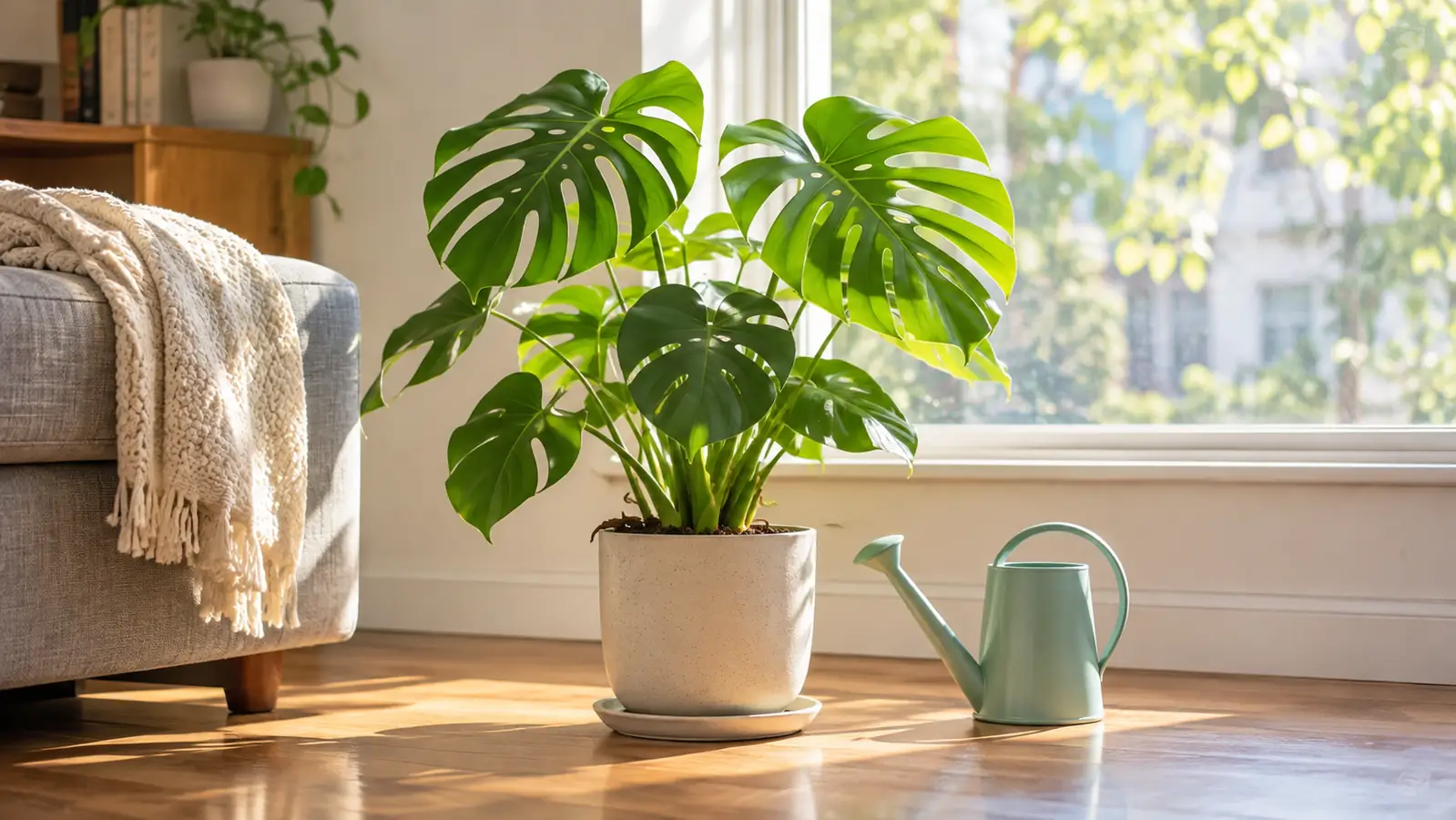
Put the plant back in the light it was already used to, not somewhere new. Repotting is stress enough without a change of room on top of it. Expect some droop for a week or two. Some older leaves yellow and drop, which is normal and not a reason to water more. In my experience the plants settle in about three weeks and start pushing new growth after that, and the moment I see that first new leaf I stop worrying.
Do not feed it, do not move it, and do not poke at the soil to see whether it has rooted. A plant that has just been repotted needs the least attention you can give it. I keep a small notebook in the kitchen drawer and write the date on it, because my memory for dates is not what it was and I will otherwise water on the old schedule out of pure habit.
After six months the feed in the mix has done its job, and that is when my usual houseplant food comes back into the routine. Not before. I put a note on the calendar six months out, because I will not remember otherwise, and I have two plants that got fed twice in one month to prove it.
One last thing about leftovers. The part bag gets rolled shut with a clip and goes back on the garage shelf, not left open on the floor. A bag left open in a damp garage is how you invite gnats into your life, and I had enough of that in April 2025.
The 6 quart bag fills four 6 inch containers. That is the number I plan a whole repotting weekend around, before I lift a single pot.
What Else Helps
Once a plant is in a bigger pot, moving it becomes the next problem. My back went out in August 2025 dragging the fig across the living room to vacuum, and that was the end of dragging. The fig and the snake plant now sit on 12 inch wood caddies, one each, rated 264 pounds, with wheels that turn all the way around and lock. The wheels stay locked all week so Biscuit cannot bump them. About once a month I pick his hair out of the wheels with a fork, and a saucer stays on top of each one so the wood does not ring up white.
Gnats are worth mentioning, because repotting invites them if you overwater, which is exactly what I did in spring 2025. Yellow sticky cards went into six pots, the gnats were clearly fewer in about two weeks, and I also let the soil dry more between waterings, because the cards on their own were not the whole fix. I keep two cards out now, in pots up high or on a sill, out of reach of the cat and the dog. They do catch the adults only, and they grab at your sleeve when you reach past, and they are not pretty.
If you are going away, repot a month before you leave, never the week of. For trips I use clay stakes with a length of hose into a one gallon jug beside the pot, no power and no batteries, water drawn up as the soil dries. Mine live in the fern, the peace lily and the parlor palm. Tucson in February 2026 was 12 days and Maine in September was 9, and all three plants were fine with the jugs about a third down. Follow the directions in the box. My first test run failed because the hose slipped out of the jug, so I tape it now. The jugs are ugly sitting on the floor, and Pepper knocked one over once, so the fern's jug stands behind the stand.
The dim dining room corner has its own floor lamp, adjustable from 17 to 61 inches, with 3 light modes and 5 dimming levels. Mine sits at about 48 inches on level 3 with the 16 hour timer. The parlor palm went in the week it arrived and put out its first new frond about 8 weeks later, in December 2025. The one thing I tried and dropped was a chunky bark mix from a garden center in 2024. It dried too fast for a Sunday watering habit, and that pothos came back to Miracle-Gro the next year.
Start with the bag, not the whole shelf
Two 6 quart bags, peat moss, coconut coir and perlite, feeding for up to 6 months. Everything else here can wait until you know you need it.
Amazon Check Today's Price on Amazon →