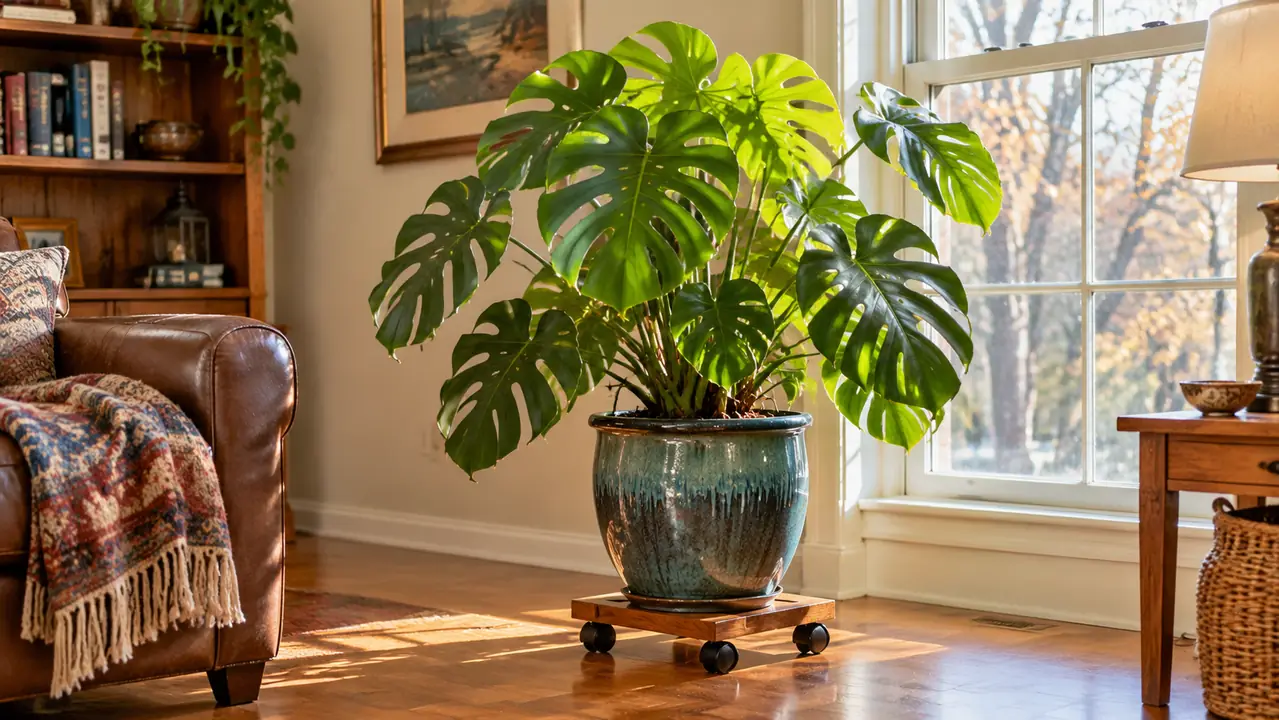
My back went out in August 2025 dragging a six-foot fiddle leaf fig away from the window so I could vacuum. Not lifting it. Dragging it. The pot is glazed, twelve inches across with an eleven inch base, and the whole thing is heavy enough that a two-inch drag put me on the floor for an afternoon. That was the day I stopped moving plants with my arms and started moving them with wheels.
I am not going to pretend this is complicated. It is five steps, and the fifth one is the one most people skip. But I did it wrong twice before I got it right, and the wrongness cost me a saucer, a water ring I can still see, and about forty minutes of picking dog hair out of an axle with a pair of tweezers. So here is the whole thing, in the order I actually do it. The caddy I use is the IDZO 12 inch acacia wood caddy, a two pack, and it has been under the fig and the snake plant since August 2025.
The caddy that ended the dragging
I bought the IDZO two pack after the vacuuming incident. 12 inch acacia hardwood, wheels that turn all the way around and lock, rated to 264 pounds. Fifteen months in, both are still under the same two pots.
Amazon See today's price on Amazon →Step 1: Measure the pot base, not the pot
Most people measure the widest part of the pot, the rim, and buy a caddy bigger than they need. Measure the base instead, the part that actually sits down. My fig's pot is twelve inches at the rim and eleven inches at the base. An eleven inch base on a twelve inch caddy sits fine, because the base is what the wood has to catch.
Then look at the floor the pot actually sits on. Mine are on hardwood in the living room and dining room, and vinyl in the kitchen. All of it rolls. If your plant lives on a rug, a caddy with wheels will fight the rug every inch of the way, so either pull the rug back or accept that the caddy is a fixed stand until you move it. My paths are bare floor by choice. It was not worth arguing with carpet.
One more measurement people forget: the ceiling, or more accurately the window. Rolling the fig four feet from the south window means four feet less light. That is fine for a few minutes while I vacuum. It is not fine for a week. Know where the pot is going back to before you move it.
Step 2: Lock the wheels before you load it
The caddy has lockable wheels and they lock hard. This matters more than the rolling part. On a bare floor, an unlocked caddy with a heavy pot on it will skate when something bumps it. I have an eleven-year-old beagle mix named Biscuit who does not know the meaning of a clear path. The wheels are locked every day of the week except Sunday, and nothing has shifted.
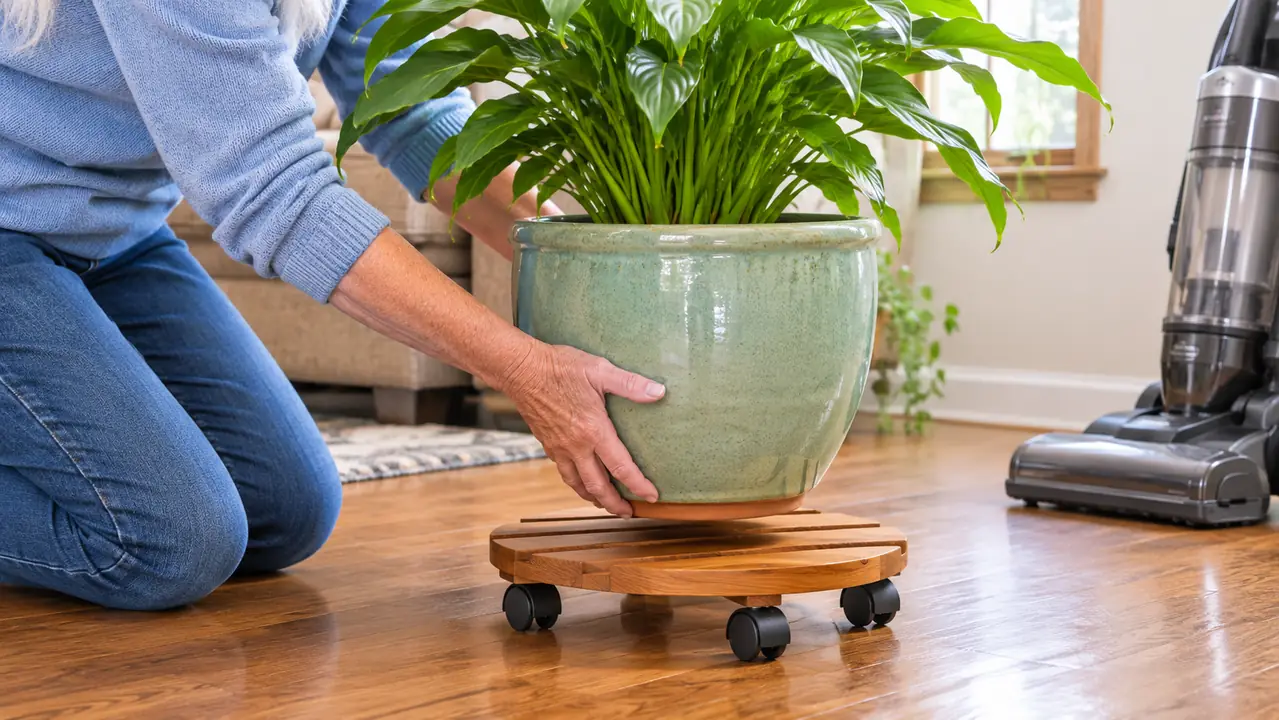
So: lock the wheels, then load. If the caddy can roll while you are lowering a pot onto it, you will chase it. Set it, lock it, and then the pot goes down. I do the loading by kneeling on the floor, tipping the pot just enough to get one edge of the base onto the wood, and sliding the rest of the way. The wood top is flat and the pot base is flat and it goes without a fight.
Do not lift the pot onto the caddy. That defeats the whole purpose. If the pot is too heavy to tip and slide even a little, get help for the first load and never take it back off. Both of mine have never come off since the day they went on.
Step 3: Put a saucer on the caddy before the plant
This is the step that cost me a water ring. Acacia wood is wood, and wood stains when water sits on it. My fig's saucer overflowed one Sunday, the water pooled between the saucer and the wood, and by the time I noticed there was a dark ring on the caddy top that has not come out. It has not hurt anything, but I see it every week.
The fix is one line long: the saucer goes on top of the caddy, not beside it. Saucer on wood, pot on saucer. Then the overflow ends up on the saucer where it belongs. I do not water on the caddy over carpet or over anything that would stain. The Sunday watering happens where the plant sits, and if a saucer overfills I dump it in the kitchen sink.
Step 4: Roll it, do not shove it
When the wheels are unlocked, the pot moves with a light push from the pot itself, not from the top of the plant. Push the plant above the pot and you are putting force into a stem. Push the pot. It rolls on the polyurethane wheels with almost no effort, and a four foot trip takes about three seconds.
Here is what I actually use it for, so you can decide if it is worth the shelf space. On Sundays I roll the fig about four feet out from the window so I can vacuum the floor underneath, and give it a quarter turn while it is out. That is the entire job. The quarter turn is the part people underestimate. A plant that gets turned keeps growing evenly instead of leaning hard toward one window. Before the caddy I turned that fig maybe three times a year. Now it is fifty-two.
I also roll the snake plant, but only when I need to get behind it. It is in a heavy glazed pot and it does not need turning the way the fig does. One caddy each, and they stay there.
Before the caddy I turned that fig three times a year. Now it is fifty-two. Same plant, same window, and it stopped leaning.
Step 5: Clean the wheels before they stop rolling
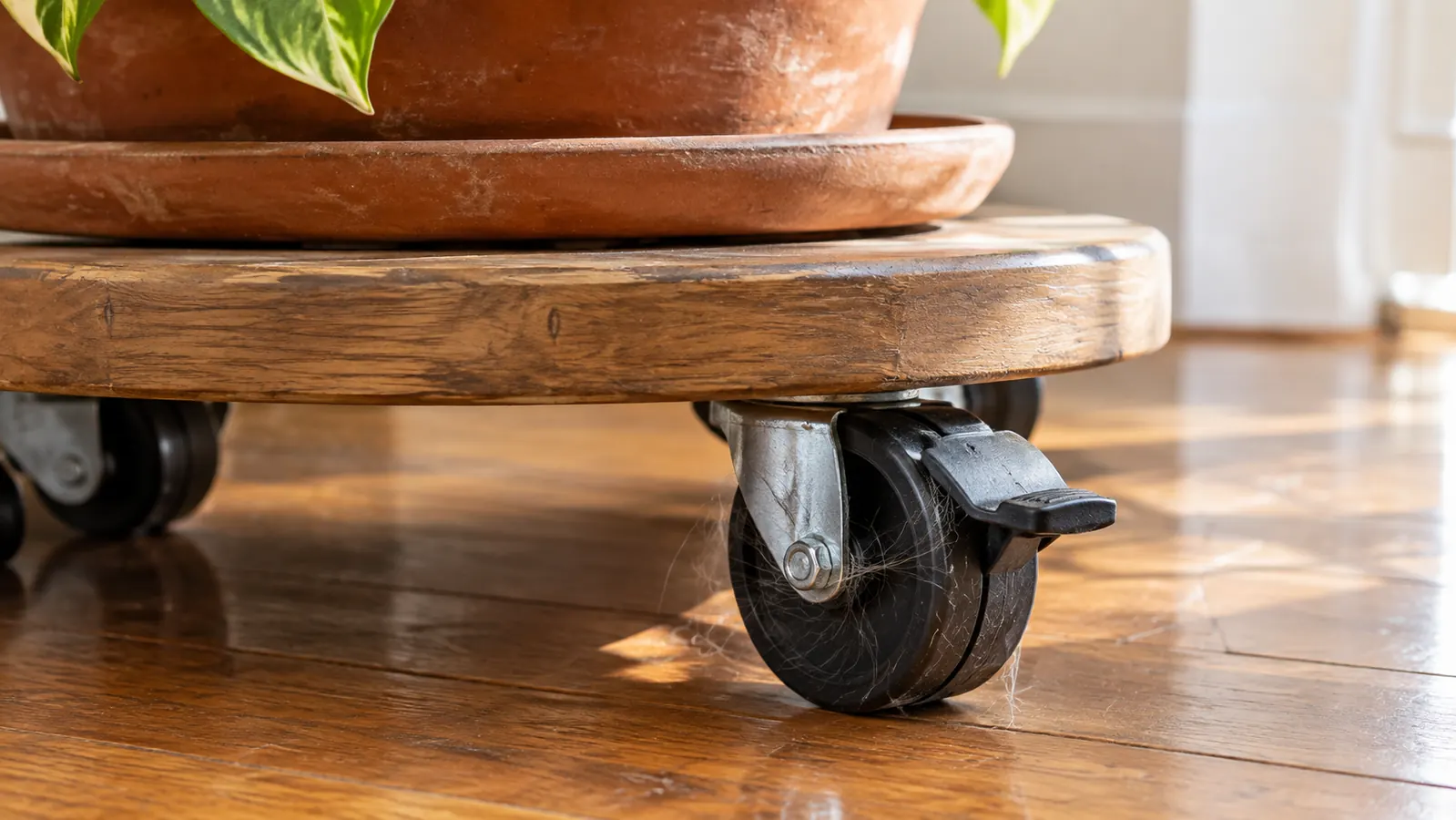
Nobody warns you about this. Wheels pick up hair, and the hair wraps the axle, and eventually the caster drags instead of rolling. I have a beagle mix who sheds year round, and his hair is the exact length that finds a caster. About once a month I turn the caddy on its side and pick the hair out of the wheel wells with tweezers, then wipe the axle area with a dry cloth.
It takes ten minutes and it is not enjoyable. Skip it and the caddy slowly becomes a stand that does not move, which defeats the purchase. If your floor is bare and your pets are short-haired, you may get away with every other month. If you have a rug, a shedder, or both, check monthly. Pepper, my gray tabby, climbs rather than sheds, so she is not the problem, but she did knock over a water jug once and I have been careful about what sits at floor level ever since.
What Else Helps
A caddy fixes the lifting. It does not fix the watering, and if you are going away, the watering is the part that actually decides whether you come home to a plant. I use Blumat Classic stakes in three pots: the Boston fern, the peace lily and the parlor palm. Each stake has a one gallon jug beside the pot with the hose in it. Clay cone in the soil, no power, no batteries, water drawn out as the soil dries. Follow the directions in the box rather than my version of them.
Run a test at home before you trust it on a trip. I did a one week test in January 2026 and the hose slipped out of the peace lily's jug, and that plant wilted while I was in the next room. Now the hose is taped to the jug. That test is the reason the Tucson trip went fine, twelve days, all three plants healthy and the jugs about a third down. Maine in September was nine days and the same result.
The rest of the collection, twenty-one plants, gets a good Sunday watering before I leave and my neighbor Deb looks in once. That is the whole plan. It is not elaborate and it does not need to be.
What the Caddy Will Not Do
It will not make a plant lighter, and it will not save you if the pot is too wide for the wood. A twelve inch caddy catches an eleven inch base comfortably. A sixteen inch pot with a fourteen inch base would hang over the edge, and I would not trust that with a heavy plant.
It also will not survive being dragged over a threshold. Mine have never left the living room and dining room floors, and I would not roll one over a door saddle with a heavy pot on it. If a plant needs to go from room to room over a lip in the floor, take the pot off, move the caddy, put the pot back. That is one lift, and one lift is what you are trying to get down to.
And it will not fix the light. The caddy moves the plant, not the window. If a plant has been sulking in a dim corner, wheels just let it sulk somewhere else. My dining room corner is far from any window and never kept anything alive, and the answer there was a floor grow light, not a caddy. The parlor palm went into that corner the same week the light arrived in October 2025, and the first new frond showed up about eight weeks later in December. Different problem, different tool.
Who This Is For
Anyone with a pot they have started to dread. If you have caught yourself looking at a plant and thinking about how you are going to get behind it, you are the person this is for. It is also for anyone whose plant never gets turned because turning it is a chore, which is most of us.
The two pack is what I bought and what I would buy again, because in practice you have two heavy pots, not one, and buying a single caddy means making the same decision again in a month. The IDZO holds 264 pounds, which is far more than my fig weighs, but the margin is the point. A caddy that is only just rated for your pot is a caddy you will not trust.
Two heavy pots, two caddies, no more dragging
The IDZO two pack is what sits under my fig and my snake plant right now. 12 inch acacia hardwood, 360 degree lockable wheels, 264 pound capacity. Fifteen months of Sundays and both are still rolling.
Amazon Check today's price on Amazon →