
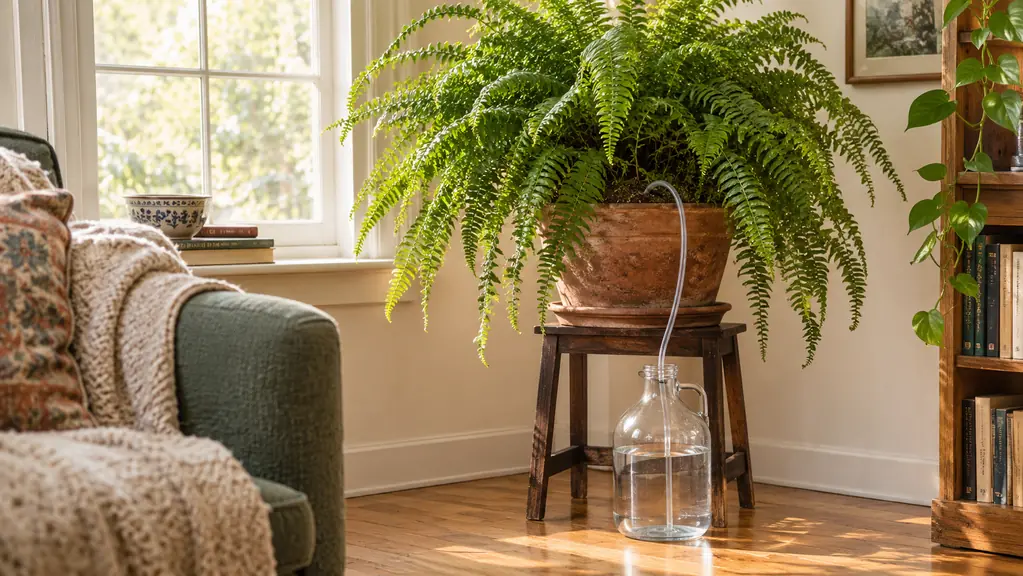
In October 2024 I pushed two plain terracotta spikes into wine bottles, watered everything on a Sunday morning, and got on a plane with Gene. Ten days later the Boston fern was brown to the soil line. Every other plant lived. That fern did not, and I have thought about it on every trip since.
I am 67, retired since 2022 after 31 years working in a school office, and I keep 24 houseplants in a one story ranch in Rochester, Minnesota. My back is why I stopped lifting pots. It is not why I stopped traveling. What follows is the order I actually do things in now, with a 3 pack of Blumat Classic stakes doing the work on the three plants that cannot go twelve days without a drink. Including the part I got wrong in January, because that part is the reason the rest of it works.
Three plants, three stakes, one jug each
The Blumat Classic stakes draw water on clay and gravity. Nothing to plug in, no batteries to remember while you are gone. Three in a pack, which is exactly enough for the three pots that show you when they are dry.
Amazon Check Today's Price on Amazon →Step 1: Pick the three plants that wilt where you can see them
A 3 pack is three stakes. Not three plants and a spare. I picked the Boston fern on the old wooden stand in the living room, the peace lily beside it, and the parlor palm in the dining room corner. All three sit in pots I can move without hurting myself, and all three tell you loudly when they are dry. A fern goes crisp at the edges. A peace lily folds up like an umbrella. The palm tips its fronds and looks embarrassed.
The fiddle leaf fig does not get one. It is about 6 feet tall in a 12 inch glazed pot, it drinks faster than any single stake is going to keep up with, and I am not putting a jug on the floor for a plant that size on top of everything else. If your biggest plant is also your thirstiest, this pack is not the tool for it. Mine gets a long drink the Sunday before we leave and a look from Deb.
The other reason to start with the loud plants is that they teach you something. If a plant does not visibly react to being dry, you cannot tell whether the stake is doing anything at all. Pick the plants that complain. They are your test equipment, and a plant that sulks at you is worth more in the first week than a plant that quietly sits there being fine or not fine.
Step 2: Fill the jug first, then set the cone
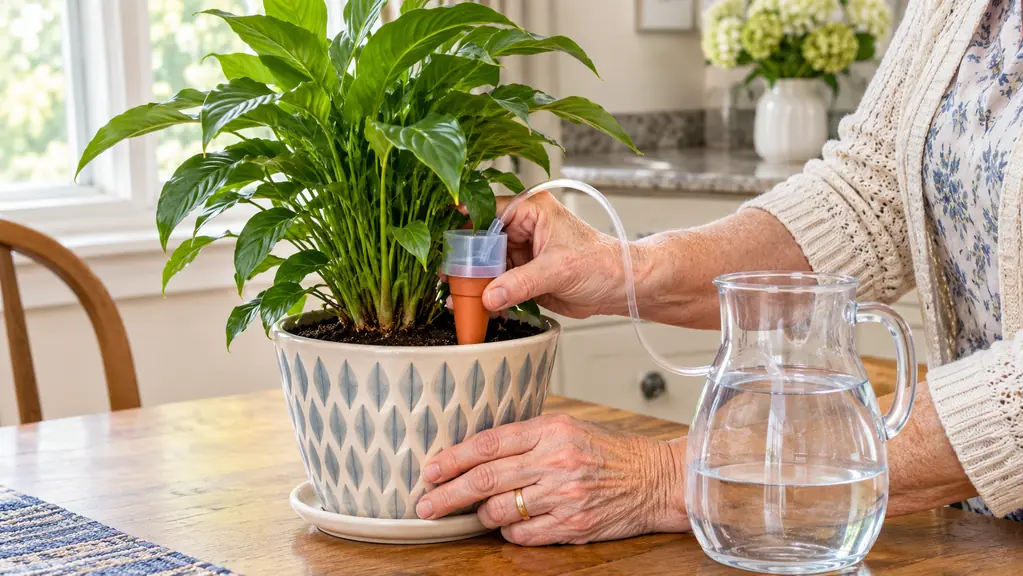
Each stake gets its own 1 gallon jug standing beside its pot, with the hose running from the stake down into the jug. That is the whole system. Clay cone in the soil, hose in the water, water drawn out as the soil dries. There is nothing to plug in and nothing to charge. That mattered more than I expected. When we came back from Tucson the clock on the stove was blinking from a power blink, and the plants had not noticed a thing.
Fill the jug and set it where it is going to live for the next two weeks before you seat the cone. If you do it the other way around, you end up shuffling a full jug around the floor trying to find a spot, and you pull the hose out of the soil doing it. Then you are standing in the living room on a Sunday with wet hands and a plant that is half set up.
Seat the cone the way the directions in the box say to seat it. That part is not complicated and it is not optional, and it is the one piece of this I will not try to describe better than the paper in the box does. Mine stay in those same three pots year round now, which is its own small advantage. I am not seating anything the morning we leave, which is the morning when I am already looking for the garage door opener.
Step 3: Run the hose where nothing will knock it
The hose is 38 inches, which is enough to get from a jug on the floor up into a pot on a stand, and not so much that you have loops of it lying in a walkway. Keep it out of the path you take to the kitchen at night. Keep it unkinked. A kinked hose is the same as no hose, and you will not find out until you are somewhere else.
In my one week test in January, the hose slipped out of the peace lily's jug and that plant wilted while I was in the same house, three rooms away, doing laundry. Nothing was wrong with the stake. The hose was lying loose and I brushed it walking past. Now I tape the hose to the side of the jug on all three, with ordinary tape from the kitchen drawer, and I have not had a repeat.
Pepper, our gray tabby, climbs, and she knocked one jug over. The fern's jug now stands behind the old wooden stand where she would have to want it badly to get at it. Biscuit is 11 and does not bother with anything on the floor, but he sheds, and his hair gets into everything that sits low. I lift the jugs and wipe under them when I do the Sunday watering, which is about twenty seconds of work and keeps me from finding a ring in the wood in March.
Step 4: Test it for a week while you are still home
This is the step I would underline twice if I were writing it on the back of an envelope for you. Do not test a new watering setup on a trip. Set the stakes up on a Sunday, fill the jugs, and then live your ordinary week. Look at the plants on Wednesday and again on Friday. Do not fuss with them in between, because fussing is the thing you will not be there to do.
What good looks like: the soil around the cone is damp, the plant looks the way it did on Sunday, and the jug has dropped a little. In a week mine go down about a quarter inch, which told me a gallon was going to be plenty for twelve days and then some. It also told me I did not need to buy anything else, which is a nice thing to learn before you leave rather than after.
What bad looks like: the top of the soil is bone dry and the plant is drooping, which usually means the hose is not in the water or the cone is not seated. Or the pot is soaking and the jug is draining fast, which means something is running that should not be. Either way you find out standing in your own kitchen instead of sitting in Tucson. You fix it, you run one more week, and that second week is the one that lets you get on the plane without a knot in your stomach.
Step 5: Water everything else well and give Deb a short list
Three stakes cover three plants. The other 21 still need the Sunday before. I water everything thoroughly that morning, including the fig, and I pull the thirstier pots back a couple of feet from the south window so they dry a little slower while we are gone. Then I stop. I do not top anything off on the way out the door, because that is how you leave a plant sitting in water for twelve days.
Deb comes in for Pepper and Biscuit. She is not a plant person and she is not asked to be. Since 2026 the list is one thing: look at the three staked plants and text me a photo if one of them looks wrong. That is the whole list. If I handed her a watering schedule she would be guessing, and guessing is how a helpful neighbor drowns a peace lily in four days while trying to do you a favor.
I also shut the door to the room with the small pots on the high shelves. Pepper will get up there if she is bored. That has nothing to do with water. It is just one less thing to think about from a hotel room in Maine at seven in the morning.
What These Stakes Will Not Do
The jugs are on the floor and they are not pretty. There is no way around that. Three one gallon jugs in a living room is a thing guests ask about, and I have gotten used to mine, but I would not call the arrangement furniture. If you need a corner that looks a certain way, put the staked pots where the company does not sit.
They also will not rescue a plant that was already in trouble. If a plant is root bound, or has been sitting wet for a month, or has lost most of its leaves, a stake just holds the soil at a steady level while the plant keeps going downhill. I learned that the hard way, and I learned it before Blumat was in this house, with two terracotta spikes that emptied in about four days and a fern that never came back. I threw those spikes out and I have not bought another kind since.
And three stakes cover three plants. That is what is in the box: a 3 pack without adapter, clay cones, a hose for each. It is enough for my three thirsty ones and nothing more. If you have eight pots that need water while you are away, count them before you order, because one pack will not stretch and two packs will leave you with spare stakes looking for a job. Mine found theirs in the same three pots, year round.
What Else Helps
The stakes handle water while you are gone. Four other things made the difference between coming home to plants and coming home to a mess.
The first is a thorough Sunday watering, not a soaking. I had been overwatering before trips out of pure guilt, and that is what gave me fungus gnats in April 2025 after I repotted six plants in one weekend. Wet soil for two weeks is worse than soil that dries out. If your plants are already sitting wet the morning you leave, no stake on the market is going to fix that, and you would be better off skipping the water entirely and going to the airport.
The second is what is in the pot. I use a bagged indoor potting mix, the kind that feeds for a while, and I keep the open bag rolled shut with a clip on a garage shelf. Plants settled in about three weeks after the March 2025 repotting weekend, six pots over one Saturday and Sunday. My gripe with it is that it stays wet longer than I expect if I keep to my Sunday schedule, which is my mistake and not the bag's, and it is not why I had gnats. Gnats were me, watering on a calendar instead of looking at the soil.
The third is being able to move a heavy pot without lifting it. The fig sits on a 12 inch wood caddy with wheels that lock, and the snake plant sits on the second one from the same 2 pack. I roll the fig about 4 feet out from the window to vacuum and to give it a quarter turn, then lock the wheels so Biscuit cannot bump it. Before the caddy I was dragging a 12 inch glazed pot across the floor with a bad back, which is how it got turned roughly never. The wood takes water rings if a saucer overflows, so a saucer stays on top and I do not argue with it.
The fourth is light, and this is the one people mix up with water. A dim corner does not need more water, it needs a lamp. The parlor palm in my dining room corner sits under a floor grow light I run on its 16 hour setting, with the head at about 48 inches and the gooseneck angled down at the palm. The first new frond showed up about 8 weeks in. A stake in that corner would have kept the soil damp and the palm would have sulked anyway, and I would have blamed the stake.
One more thing, about the pets, because people ask me. I keep the sticky traps and the small pots up where Pepper cannot get to them, and I do not let either animal chew on a plant or a stake. If you want to know whether a particular plant is a problem for a cat or a dog, ask your vet and bring the name of the plant with you. I am not the person to tell you that, and neither is a listing on a website.
Tucson, 12 days, all three plants fine and each jug about a third down. Maine, 9 days, the same. The week I tested at home in January is the week that made both trips work.
Start with the three pots that tell you when they are dry
A clay cone, a 38 inch hose, and a jug you already own. Set them up a week before you leave, watch them for seven days, then go. The Blumat Classic 3 pack covers three plants and asks for nothing but water.
Amazon Check Today's Price on Amazon →