
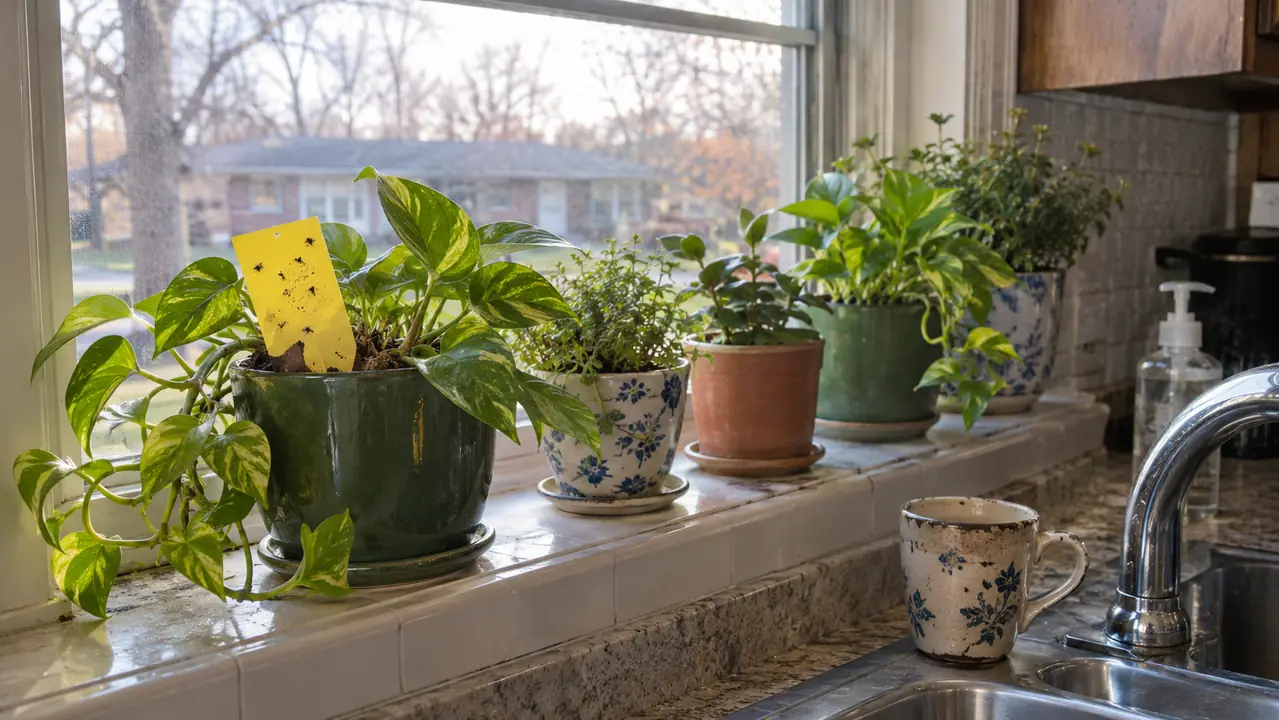
The gnats showed up in April 2025, about three weeks after I repotted six plants over one Saturday and Sunday and then watered everything on my usual schedule like nothing had changed. Little black flies lifting off the kitchen sill every time I walked past it. I have 24 houseplants in this one story ranch, and overnight every last one of them looked guilty. If you are reading this with a cup of coffee and something hovering over the peace lily, I know exactly where you are standing.
My first move was a soil drench from the garden center. No brand worth naming. It eased things for about three weeks and then the gnats came back, so I stopped there and have never bought another one. What actually changed things was a 36 pack of Stingmon yellow sticky traps in May 2025, six cards pushed into six pots, plus one honest change to how often I water. In about two weeks the kitchen was livable again. It is November 2026 as I write this and I still keep two cards out at all times.
Six cards, six pots, and about two weeks
The Stingmon 36 pack is what I bought in May 2025 and what I still keep in the kitchen junk drawer. The pointed bottom goes straight into the soil. Nothing to mix, nothing to plug in.
Amazon Check Today's Price on Amazon →Step 1: Find out which pots are actually hatching them
Fungus gnats do not drift in from the yard. They come out of wet soil, which means the pots that stay damp longest are the ones raising them. Before I set a trap anywhere, I go around with one finger and push it into the top inch of every pot on the sill and the high shelves. Whichever pots are wet two days after a watering are the suspects.
I counted them one morning with a pencil and the back of an envelope, tapping each pot rim with a knuckle and watching what lifted off. Nine flies on the kitchen sill, four on the high shelf by the living room window, none at all in the dining room corner. That is how I ended up treating six pots instead of twenty four, and the count took ten minutes I would otherwise have spent swatting at nothing.
In my case the six were the ones I had just repotted. I used two 6 quart bags of a bagged indoor potting mix in March 2025, over one weekend, and that fresh mix held water longer than I expected when I kept to my Sunday schedule. That was my mistake, not the bag's. The label lists peat moss, coconut coir and perlite and says it feeds for up to 6 months. None of that is the point. The point is that a pot staying wet is a nursery.
The pots that were dry at the top were not the problem, so I left them alone instead of treating all 24. That one decision saved me a third of the pack. If you only have three or four plants, this step takes about ninety seconds.
Step 2: Let the top inch dry before you set a single trap
This is the step people skip, and it is the step that decides whether the traps do anything at all. A sticky card catches the adults flying around. It does nothing to the eggs and larvae in the soil. If the soil stays wet, you get a fresh batch of adults every couple of weeks and you will be buying cards until you are sick of them.
So I let the top inch dry between waterings. Not the whole pot, just the top inch, checked with the same finger from Step 1. My Sunday habit is what got me into this and I had to break it. Some weeks a plant waits until Tuesday or Wednesday. Nothing in this house has died from that.
For what it is worth, the chunky bark mix I tried on one pothos in 2024 dried much faster than the bagged mix, too fast for me, and I never bought a second pot of it. I am not telling you to switch mixes. I am telling you that a mix that stays wet is the reason you have gnats, and drying the top inch costs nothing.
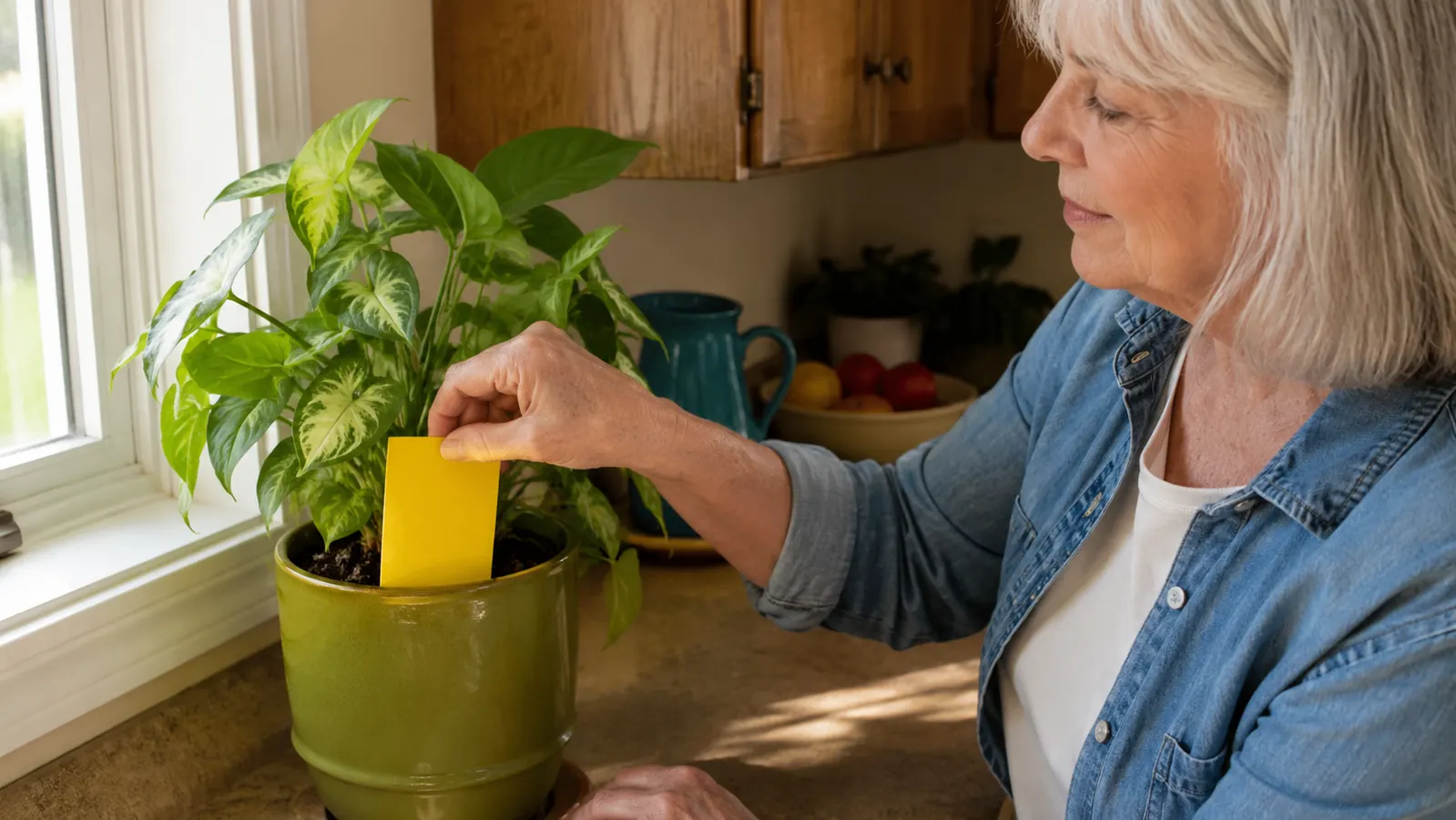
Step 3: Push the cards in pointed end down, right at the soil line
The Stingmon cards are 3.15 inches wide and 5.2 inches tall, made of plastic, and they have a sharp bottom meant to be inserted directly into the soil. I push one into each affected pot until the bottom edge sits just above the surface, then part the leaves so the face of the card is clear. That is the whole installation. No mixing, no plug, no batteries. The listing says the power source is manual and that is accurate.
Six cards went into six pots the first week of May 2025. I did not put one in every plant I own. They went into the six that were wet and had flies sitting on the rim, which is the same six from Step 1. The cards are dual sided, so I do not fuss about which way the face turns.
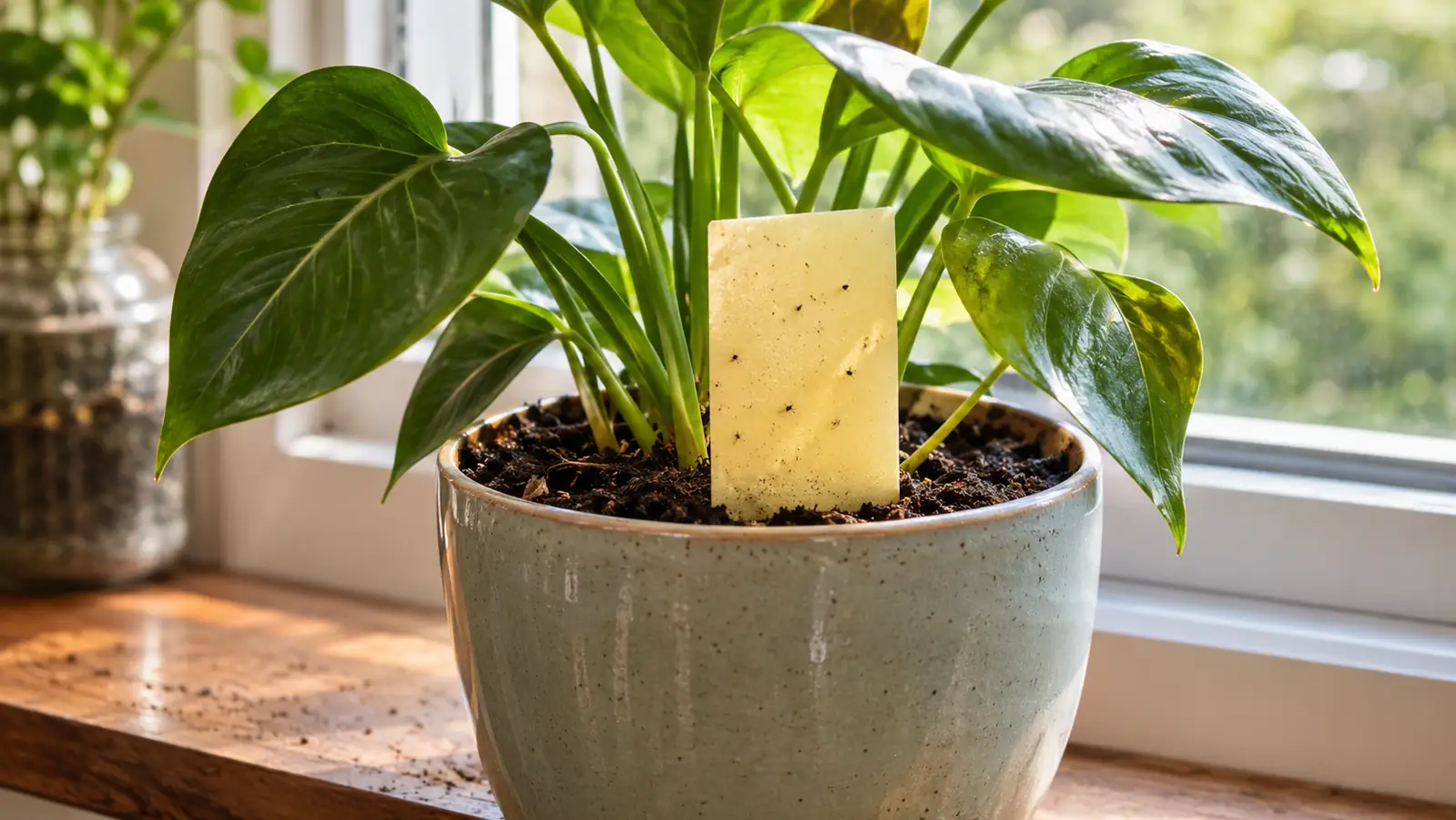
The first week I checked them every morning, which is not necessary but it is what I did. By day four the card in the wettest pot had a scatter of small dark specks across the lower half and the pot beside it had almost nothing on it. By day ten the first card was worse and the second pot was catching up. That is the real timeline, not overnight, and I would rather you expect that than give up on day three.
Two things I learned by doing it wrong. Do not push a card so deep that the sticky part touches the soil, because it picks up grit and stops being sticky. And do not tuck a card behind a leaf to hide it. The adults land on the open surface of the soil, not in the shadow of a leaf, so the card needs to be the tallest thing in that pot for the first week.
Step 4: Put them where the flies land, not where they look tidy
Placement took me longer to get right than the traps themselves. The kitchen sill under the east window is where I first noticed the gnats and it is also where the cards did the most good, because that is where the small pots sit and where the flies were already landing. Two cards on that sill did more than six spread evenly through the house.
I tried one in the dim dining room corner first, purely because that corner annoys me, and it caught nothing in three weeks. The parlor palm there has never had a gnat problem, which I could have worked out from Step 1 if I had been thinking straight. The cards went where the wet pots were, and the dining room kept its grow light and its clean card. Nothing wrong with a clean card. It just is not doing any work there.
Everything in this house gets inspected by the pets before I get to it. Pepper is 9 and climbs, so a card on a low shelf is a card in her reach. Biscuit is 11 and a beagle mix, and his tail clears a coffee table without him noticing. So cards go only in pots on high shelves and window sills, up and back. I am not going to tell you a glue card is safe or not safe around a cat or a dog, because I do not know and neither does a plant blog. I keep them up, and if you have a chewer in the house, that is a question for your vet.
The honest gripe, and I have had eighteen months to develop it: these cards are ugly, and they grab my sleeve and my hair every single time I reach past the sill. I have made peace with it. A small flat card that I have to peel off my cuff beats a fly in the coffee.
Step 5: Swap on a schedule and keep going after the last fly
I keep two cards out at any time now. When one is covered, I pull it and push a new one in. In practice that works out to about every four weeks, which lines up with a pot check anyway. Two cards a month is not a routine I have to remember, which is the only kind of routine that survives in this house.
I swapped the last pair on a Sunday morning in October, the same morning I watered, because tying it to a job I already do is the only way it gets remembered. The old card came out stiff with grit and specks and went straight in the bin. The new one went in the same slot, pointed end down, leaves parted. Two minutes, tops, and then the watering can was still full.
The card also tells you something no amount of staring at the soil will. If it fills up in a month, you still have a breeding population and the top inch is not drying out enough. If it stays mostly clean through a month, you are done and the card is just insurance. I would rather look at a clean card than guess.
The other half of this step is patience. Keep the cards up for a month after you stop seeing flies, because the ones you cannot see are the ones that restart the whole thing. I bought the Stingmon 36 pack in May 2025 and about half of it is still in the kitchen junk drawer, so at two cards a month a pack this size lasts a long time. One note from the listing worth repeating: when the house warms up in summer, the glue can soften.
What Else Helps
The drench. I tried a garden center soil drench once, in April 2025, before the traps. The gnats eased off for about three weeks and came right back. I know people who swear by them and I am not the one to ask. My answer is still the cards plus dry soil.
New plants get looked at before they come inside. If the top of the soil is damp and something lifts off when I tap the pot, that plant sits by itself in the garage for a couple of weeks with a card in it. That is the entire quarantine. No sprays, no rinsing the roots in the sink.
Since August 2025 the fig has sat on a wood caddy with locking wheels, and it stays there with the wheels locked so Biscuit cannot bump it. That was about my back and not about gnats, but it did make the pot checks easier. Biscuit's hair wraps the wheels about once a month and I pick it out. A saucer stays on top of the wood, because an overflow leaves a ring I cannot get out.
One caution about vacation gear. In January 2026 I set up three clay stakes with one gallon jugs for the fern, the peace lily and the parlor palm so I could get away to Tucson for 12 days in February and to Maine for 9 days in September. Tucson and Maine both went fine, the jugs were about a third down. But those stakes keep a pot evenly damp, which is the opposite of what you want in Step 2, so I would not put one in a plant you are trying to dry out. If a hose slips out of a jug it also wilts the plant, which happened to my peace lily during the January test run, so now I tape the hose to the jug.
Six cards in six pots, and in about two weeks I could sit at the kitchen table without waving a hand over my coffee. The traps did not do it alone. Drying the top inch did the other half, and that half was free.
Two cards a month, half the pack still in the drawer
The 36 pack of Stingmon traps is what I keep on hand. Pointed bottom into the soil, leaves parted, swap it when it fills. That is the whole method, and eighteen months in it is still the one thing in this house that works on gnats.
Amazon Check Today's Price on Amazon →