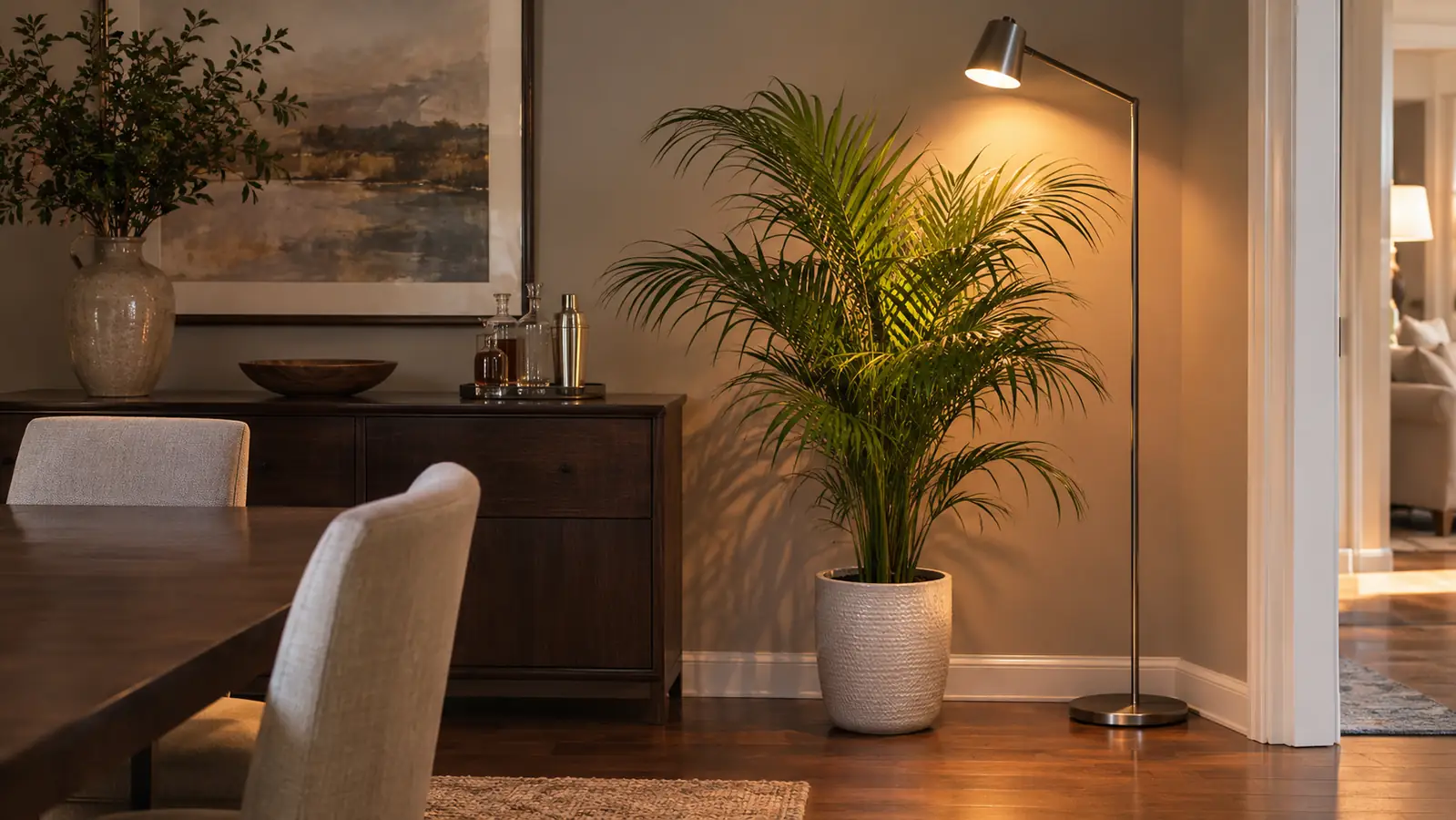
The north corner of my dining room is where plants go to give up. It sits about 14 feet from the south window in the living room with a wall in between, so what reaches that corner is not sunlight, it is the memory of sunlight. I put a pothos there in 2023 and it lasted five months. I tried a spider plant the next spring and got about the same. After 31 years in a school office and four years of retirement I keep 24 houseplants, and I know a losing spot when I see one. In October 2025 I stopped pretending that corner would fix itself and bought an Aumtrly floor grow light, the full spectrum one on the tall stand. I bought a parlor palm the same week so I would have something to judge the lamp by. That was 13 months ago.
A floor grow light is a lamp on a stand, not a window. I say that plainly because the listing photos make it look like more than it is. The Aumtrly light I have is 20 watts and 80 LEDs at 5000 Kelvin, with a stand that goes from 17 inches to 61 inches and a head on a short gooseneck. It lights one corner well. It does not light a room. If you are picturing a brighter dining room you will be disappointed. If you are picturing one plant that stops dying, you are in the right place. I had already tried the cheap version. In 2024 I bought a clip-on desk grow light and clamped it to the kitchen shelf over the small pots. It is still there and still fine for cuttings. It could never reach anything tall, which is why the dining room corner stayed dark for another year.
The corner that killed three plants now holds one that grew.
Aumtrly floor grow light, 20 watts and 80 LEDs on a stand that adjusts from 17 to 61 inches. It lit one dim corner and nothing else, which is exactly what I needed it to do.
Amazon Check Today's Price on Amazon →Step 1: Measure the corner before you buy anything
You need three things before you order a floor lamp, and none of them is the plant. You need the height, the outlet, and the walking path. Height first. The stand adjusts from 17 inches to 61 inches, so an 8 foot ceiling is not a constraint. What matters is how high the head has to sit above the plant you have in mind. Mine sits at about 48 inches with the head angled down at a palm that was 26 inches tall when it went into the corner. Measure from the floor to roughly two feet above the top of the plant and you have your number, as long as it lands between 17 and 61.
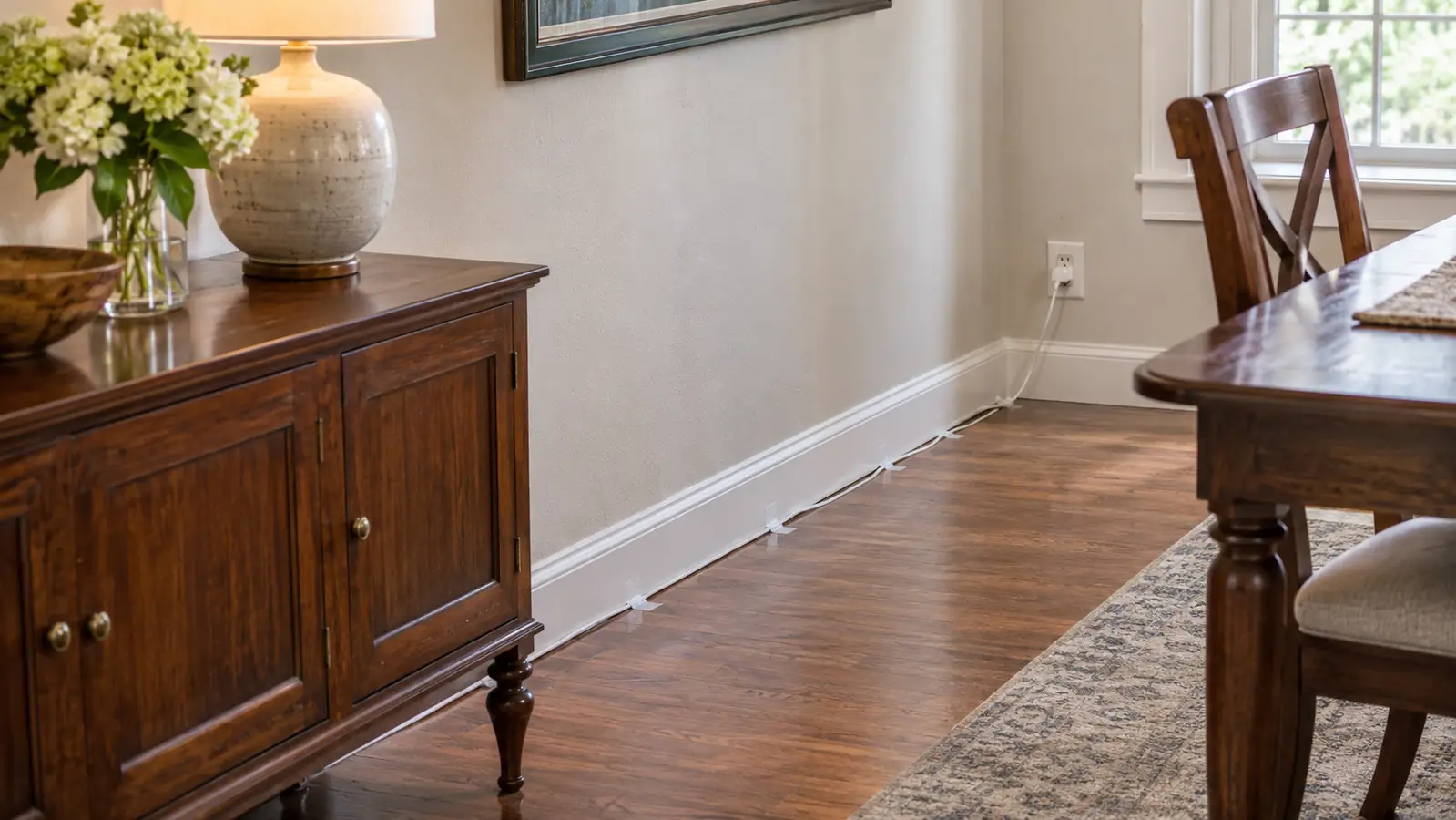
Second, the outlet. A corded lamp is only as good as the place you can plug it in. The nearest outlet in my dining room is behind the sideboard, so the cord runs along the baseboard and is taped down every foot or so. It is not pretty. It is also not in the way, and after a week I stopped seeing it. The adapter comes in the box, so there is nothing else to buy. If the only outlet is across a doorway, pick a different corner. A cord stretched across a walking path is how lamps get pulled over.
Third, who walks through. My dining room sits between the kitchen and the living room, so Gene crosses it every evening and Biscuit the beagle crosses it more often than that. The base needs to sit where a hip will not find it in the dark. I also sat at the table with the lamp switched on before I settled on the final spot, because a head aimed the wrong way shines straight into your eyes over dinner. That is not a small thing. It is the difference between a lamp you use every day and one you unplug in November.
Step 2: Pick the one plant that gets the light
This is a one plant lamp. I want to be honest about that, because 20 watts and a single head do not stretch. It lights the corner the lamp stands in, not the corner beside it. So choose the plant that will actually benefit and stop thinking about the rest of the collection. I bought a parlor palm the same week the lamp arrived, partly because a palm in a dim corner looked right to me and partly because I wanted a plant that would show me something within a season rather than pretending to think about it for a year.
Here is what did not get the light, and why. The fig is about 6 feet tall in a 12 inch glazed pot and lives by the south window where it is happy. The snake plant is in a heavy glazed pot in the living room and has never complained. The small pots on the kitchen sill have had that clip-on light above them since 2024. If I had put the floor lamp in the living room, I would have wasted money adding light to plants that already had some, and I would still have had a dead corner.
One more thing about choosing. Do not buy the plant the same week and expect it to tell you anything for a month. Mine spent its first weeks settling, dropped a lower frond, and did nothing visible. That is normal. It is also not the lamp's fault, and if you decide it is, you will move the plant and start over.
Step 3: Assemble the stand and set the height before you aim anything
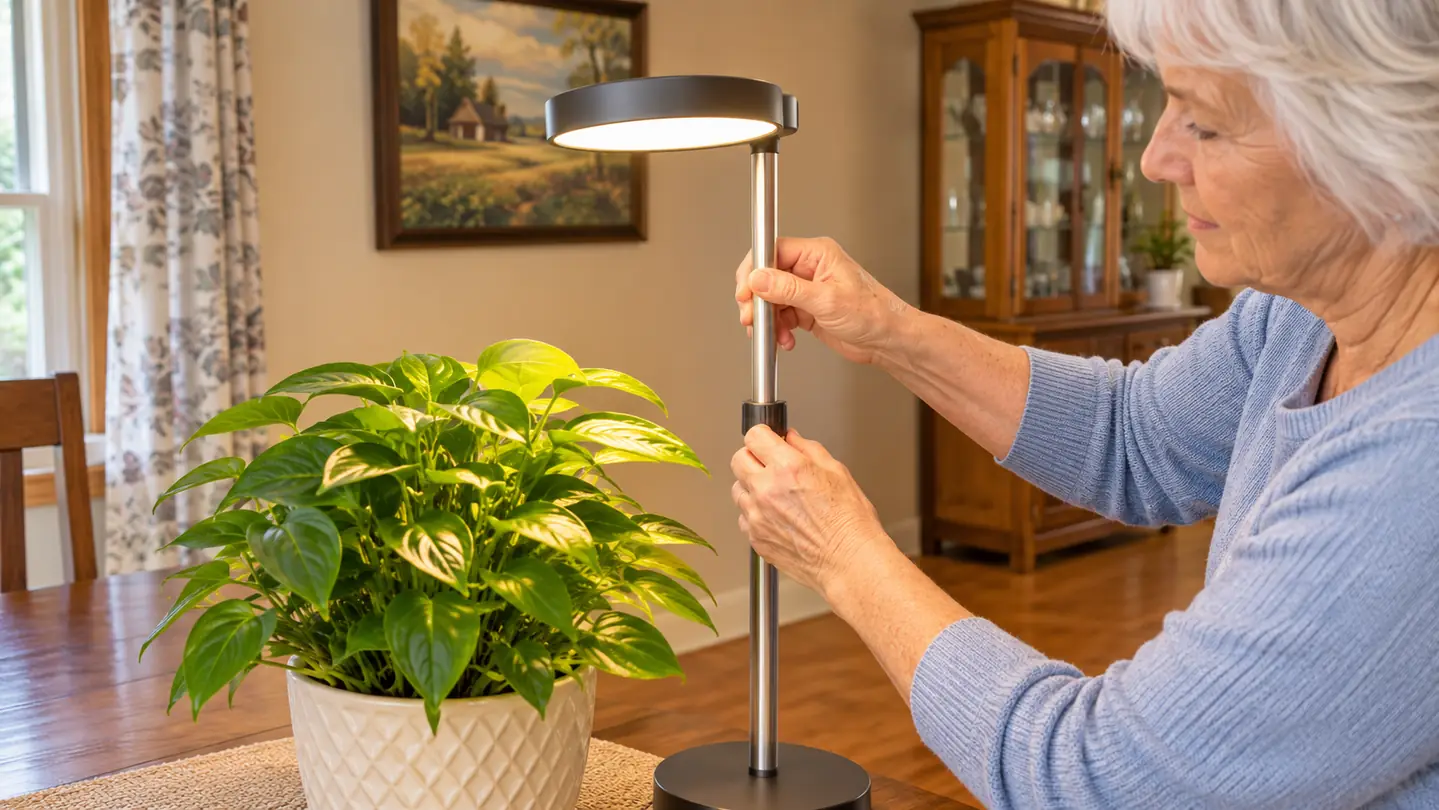
The box has a base, two connecting rods, a telescopic rod, the head, and the adapter. The Aumtrly stand is aluminum with a matte finish and the whole thing weighs about a kilogram, so it is easy to move and easy to knock into. I put mine together on the dining room floor in about ten minutes with the instructions open on the table. Nothing needs tools beyond what comes in the box.
Build it from the base up. Put the base where you want it, add the connecting rods, then the telescopic rod. The height changes by rotating the metal ring on the bracket and pulling the rod out to where you want it, then turning the ring back. Do that with the lamp unplugged and the head loose, set your number, and tighten once. Doing it after the lamp is aimed and on is how you end up readjusting three times and giving up at 44 inches.
Then step to the far side of the room and look at it. I had my base three inches into the walkway the first time and moved it after one evening. The floor in my dining room is hardwood with no rug on the path, so a bumped stand slides. If yours is on a slick floor and a dog or a grandchild passes through, put the base tight to the wall and run the cord behind the furniture rather than across open floor.
Step 4: Aim the head, pick one setting, set the timer, and leave it alone
The head sits on a 7.8 inch gooseneck, so you can bend it down over the plant. Mine is aimed down at the palm from roughly two feet above the tallest frond rather than straight across the room. That angle matters more than the setting you choose. Aimed sideways the light hits the wall and your eyes. Aimed down it lands on the leaves, which is the point.
There are 3 lighting modes and 5 dimming levels. I tried all three modes in the first week and then set it on one and never touched it again. I stay on level 3 for dimming. More is not automatically better, and 20 watts aimed too close is still 20 watts aimed too close. If the back of your hand feels warm after the head has been on for an hour at the level you chose, raise the head a few inches and check again the next day.
The timer runs 16 hours and that is the setting I use. I have never used another one. It comes on in the morning, goes off in the evening, and I do not think about it again until the days change in the fall. The one gripe I have is the same one I had in week one: if the head gets turned toward the table it is bright in your eyes at dinner, and the cord had to be taped along the baseboard because there is no other way to hide it. That is the whole list of what annoys me about it, 13 months in.
Step 5: Give it eight weeks and change nothing else
This is the hardest part of the whole article. After you set the lamp, do not also repot, do not also start feeding, do not also move the plant to a different corner to see if it likes it better there. If you change three things and the plant improves, you will never know which one did it, and if it declines you will not know what to undo. Water on the day you always water. For me that is Sunday morning, and it stayed Sunday morning straight through the winter.
My palm opened its first new frond the second week of December 2025, about eight weeks after the lamp went on. Not a burst of growth. One frond, unfurling slowly out of the center, and a second one behind it in February. That is the entire proof I have, and it is enough for me. A plant that had never survived that corner produced new leaves on a schedule I could see.
If nothing happens at eight weeks, check the plain things first. Is the timer actually on. Is the head pointed at the plant and not at the wall behind it. Has the plant been sitting in water in its saucer. Is the corner cold at night because it is next to a door. Those four questions cover most of what goes wrong at this stage, and none of them is solved by buying a second lamp.
What Else Helps
The light does not solve the weight problem, and if you have a bad back you will find that out the first time you drag a big pot across the floor to vacuum. In August 2025 I bought a 12 inch wood plant caddy, a 2 pack, one under the fig and one under the snake plant. The wheels turn all the way around, they lock, and the thing is rated to 264 pounds. I lock them the rest of the week so Biscuit cannot bump the pots. Biscuit's hair wraps the wheels and I pick it out about once a month. Water rings show on the wood if a saucer overflows, so the saucer stays on top of the caddy.
The light does not water anything either. For travel I use clay stakes, a 3 pack, one each in the Boston fern, the peace lily and the parlor palm, with a 1 gallon jug beside each pot and the hose in the jug. No power and no batteries. I ran a one week test at home in January 2026 before we left for Tucson, and the hose slipped out of the peace lily's jug and that plant wilted, so now the hose is taped to the jug. Tucson was 12 days and Maine was 9, and both times the jugs came back about a third down and all three plants were fine. The other 21 got a good Sunday watering before we left and Deb looked in once. Follow the directions in the box for the stakes themselves, because the setup details matter more than they look like they do.
Two smaller things. Fungus gnats showed up in April 2025 because I overwatered freshly repotted plants, and yellow sticky cards cut the adults down while I let the top of the soil dry out between waterings. I keep 2 cards out at a time now, only in pots on high shelves or sills, out of reach of the cat and the dog. They catch adults only, so they are not a fix on their own. And I repot with a bagged indoor mix that feeds for up to 6 months, then go back to my usual houseplant food. If Pepper or Biscuit chews plants, ask your vet about that specific plant. No lamp and no bag of soil can answer that question for you, and I would not trust anyone who says otherwise.
The first new frond opened the second week of December 2025, about eight weeks after I plugged the lamp in. That is the whole proof I have, and it is enough for me.
One corner, one lamp, one palm that is still alive 13 months later.
20 watts, 3 lighting modes, 5 dimming levels, a stand from 17 to 61 inches and a gooseneck head. If your dim corner has already killed a plant or two, this is the plainest fix I know.
Amazon Check Today's Price on Amazon →