
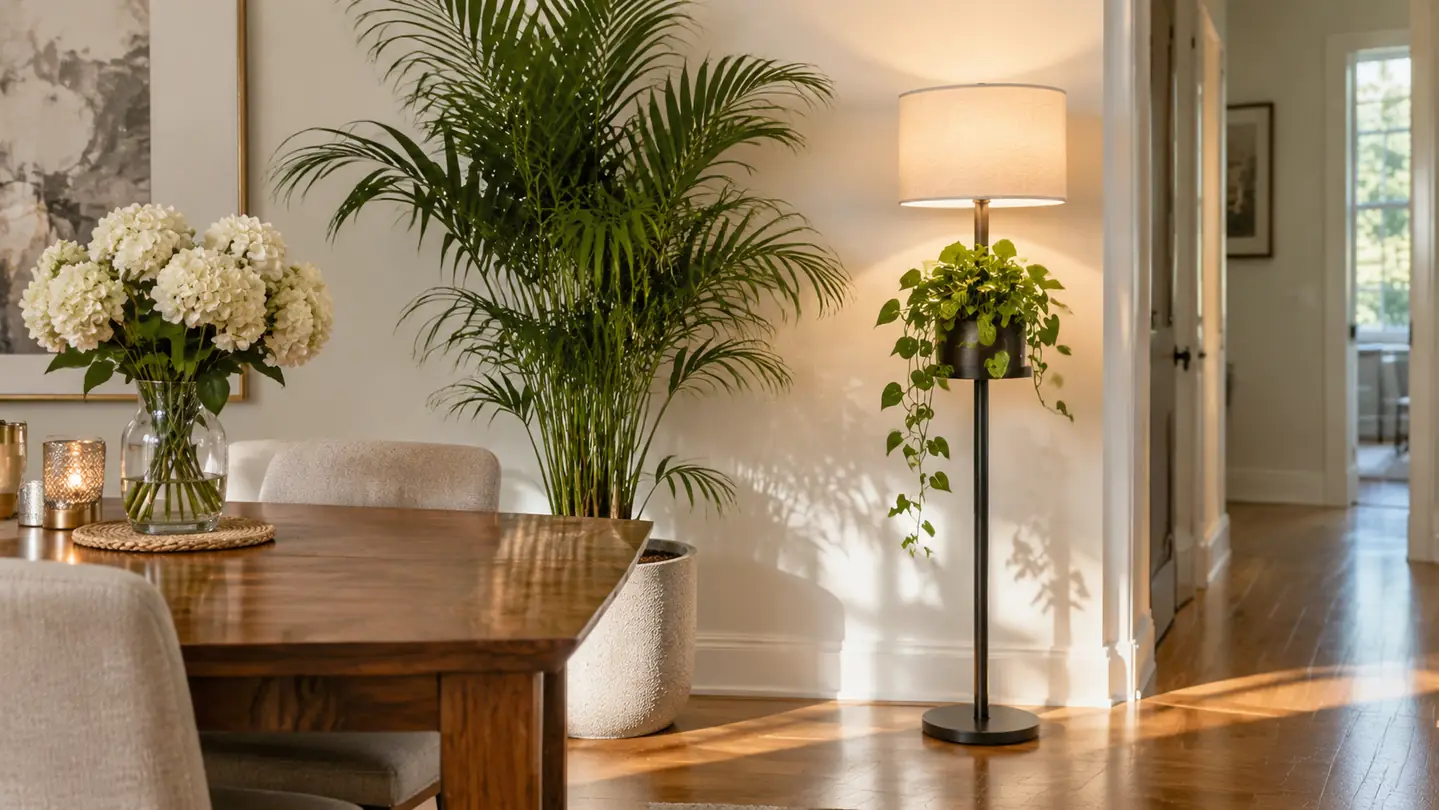
I bought the Aumtrly floor grow light in October 2025 for one corner of one room and one plant. That is the whole of it, and I want to say so up front, because most write-ups of a lamp like this read as though it will fix a whole house. The corner is in my dining room, on the north side, as far from a window as any spot in this ranch house. Three plants died there before I gave up, and I had given up for two years. I am 67, retired after 31 years working in a school office, and I keep 24 houseplants, so one dead corner was not a tragedy. It was an annoyance I walked past every day, usually carrying something, usually on my way to the kitchen.
The box held a base, a telescopic rod, two connecting rods, an adapter and a folded sheet of directions. I read the directions twice, which is once more than I read most. Thirteen months on, the Aumtrly is still in that corner, still switched on most days, still doing the one job I bought it for. What follows is what I would want a friend to tell me before spending the money: the parts that irritated me, the mistake I made for a whole month, and the one job it will not do no matter how you set it up.
The Quick Verdict
One lamp for one dead corner. It kept a palm alive where three plants had already failed, and it did it without any fuss.
Amazon Check Today's Price →The lamp I would buy again for a corner with no window
Thirteen months, one palm, three lighting modes and five dimming levels. If your dark corner has already killed two plants, this is the one I would start with.
Amazon Check Today's Price on Amazon →How I've Used It
I put it together on a Saturday in October 2025 on the living room floor and I did it alone, which tells you the weight is manageable. The listing puts the whole thing at 1 kg. I bought the parlor palm the same week, brought it home in the back seat of the car, and set it in the corner with the lamp behind it. For the first two weeks I fussed with the height every other day, which was unnecessary and slightly silly. What the lamp needed was for me to pick a height and leave it alone.
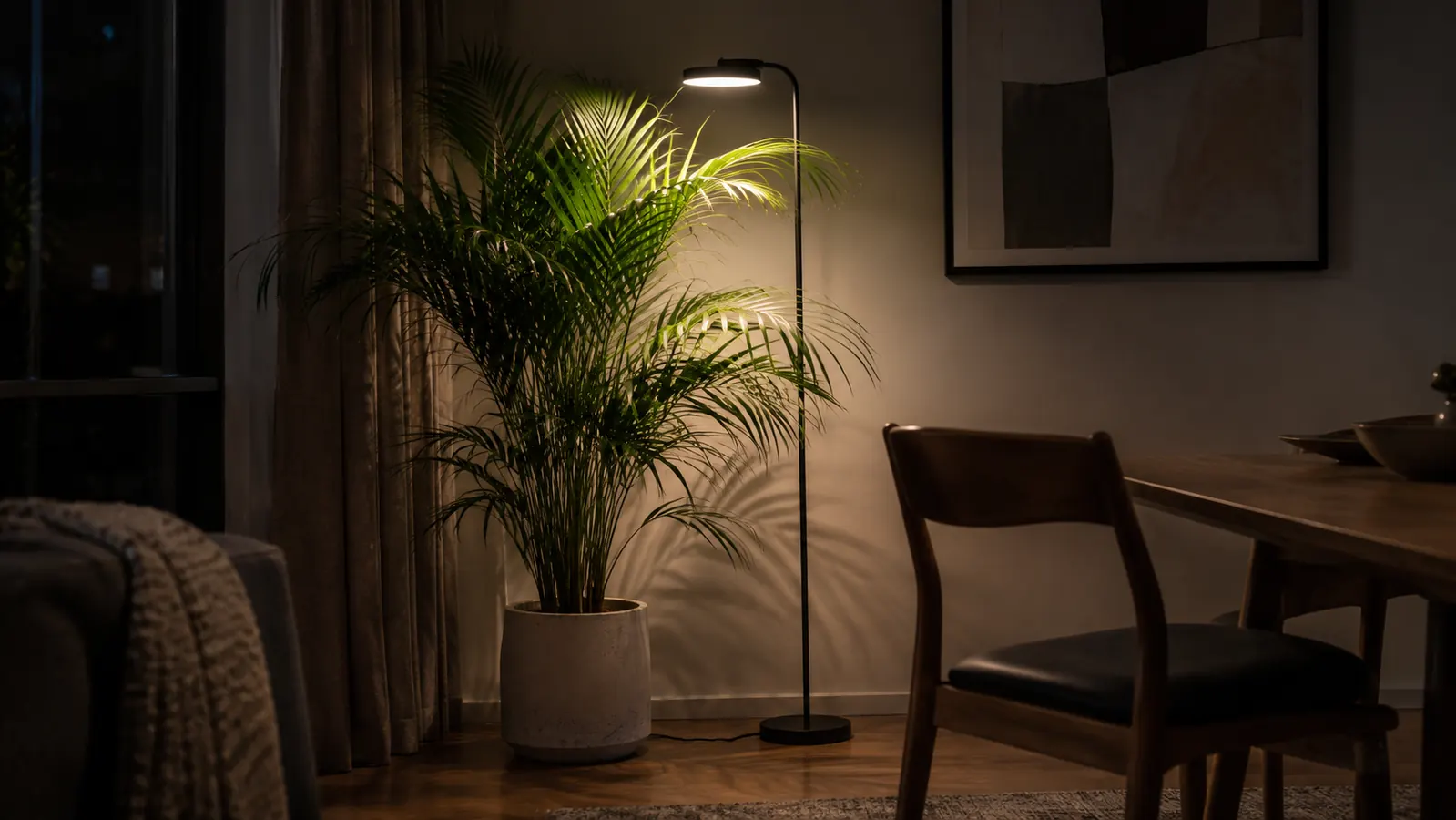
Mine sits at about 48 inches on the stand, roughly chest height on me, with the head angled down over the palm. The stand adjusts anywhere from 17 to 61 inches, so there is range in it if you have a plant on a low stool or something tall and narrow in a corner. There are three lighting modes and five levels of dimming. I tried all of them in the first week and have stayed on level three of the middle mode ever since, because that is the setting where the dining room still looks like a dining room instead of a waiting room.
My routine has not changed in a year. I switch the lamp on when I get up, a little before seven, and off after supper. I turn the palm a quarter turn on Sunday morning when I water. I wipe the head with a dry cloth every couple of weeks and pick any dried frond out of the pot. That is the whole of the maintenance. I do not own a light meter and have no intention of buying one. The plant either looks better or it does not, and after thirteen months I can tell you plainly that it does.
The stand is matte aluminum and the head is round, and neither has given me a moment of trouble. Nothing has loosened or wobbled in a year. I have leaned past it with a laundry basket, caught it with the vacuum twice, and it has not tipped. The matte finish does not show fingerprints the way a shiny stand would, which matters more than it sounds like it matters when the thing is standing in the room where you eat.
What Nobody Tells You Before You Buy One
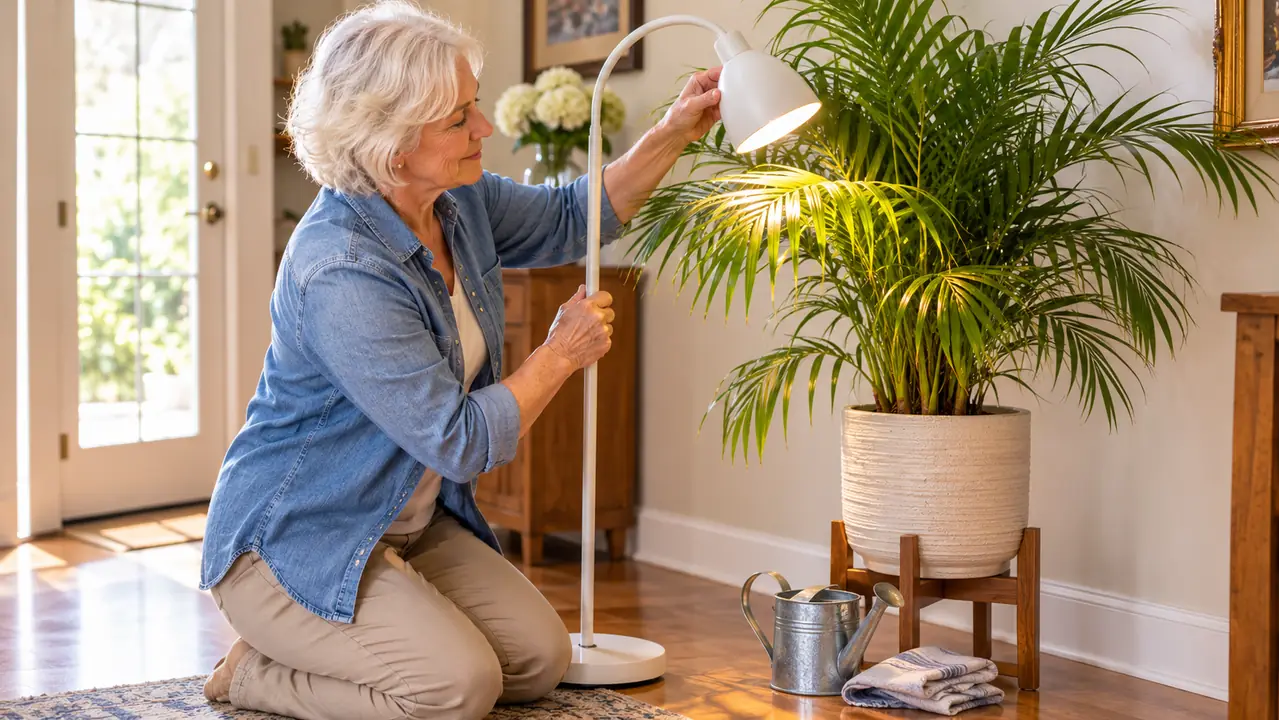
Nobody tells you it is a lamp, not a window, and a lamp does exactly one thing: it puts light where you point it. The Aumtrly is 20 watts from 80 LED light sources at 5000 Kelvin, and that reads as white daylight. I had braced for the pinkish glow people picture when they hear the words grow light, and I got something closer to a bright reading lamp. If you were hoping for a piece of furniture that vanishes into the room, this is not that. If you wanted the corner to look like a corner that gets sun, it does.
Nobody tells you that height matters more than brightness. When I first raised the stand to its full 61 inches, the head sat so far above the palm that nothing changed for a month. I lowered it to 48, which put the light roughly 14 inches above the top frond, and that was the change that mattered. I measured it with Gene's yardstick, which he found funny. A floor lamp you cannot adjust would have been useless to me. The adjustability is not a nice extra on this one. It is the reason it works.
Nobody tells you that you will notice the light in the room long before you notice it on the plant. Mine stands in a corner of the room where we eat. For the first month it was aimed so that anyone on the far side of the table caught it in the eyes, and Gene mentioned it twice before I moved it. That is not the lamp's fault, it is mine, but if you are putting one in a room you use after dark, plan where the head points before you plan anything else.
The first new frond opened in December 2025, about eight weeks after I set the thing up. Before that, nothing in that corner had lasted a season.
The Eight Weeks Before Anything Happened
I want to be honest about the timeline, because timelines are what most reviews leave out. I set the lamp up in October 2025. Nothing visible happened in October. Nothing visible happened in November. The palm did not yellow, which was already better than the three plants before it, but it also did not grow. I checked it every Sunday the way you check a cake through the oven door. I had about decided I had bought a floor lamp for the look of the thing when the first new frond opened in December, roughly eight weeks in.
That frond came out pale and soft and took another three weeks to darken and firm up. Since then the palm has opened four more, the newest in September 2026, and it has dropped two old lower fronds along the way, which is what palms do. That is the whole performance record: five new fronds in thirteen months and one plant still alive in a corner where nothing used to survive. If you want a number, that is the number, and I am not going to dress it up. A younger plant in fresher soil might do more, and I would not know.
What I cannot tell you is how it would do with anything else. I have one lamp and one palm and I have not moved it. I did not buy it for seedlings and would not, because a floor lamp in a dining room is the wrong shape of thing for a tray of six small pots. I did not buy it for the fig either. The fig lives at the south window where it is happy, and dragging it into a dark corner to test a lamp would have been a silly thing to do to a plant I have had for years. One lamp, one plant, one corner. That is the test I ran.
There is also a household to think about. Pepper is nine and climbs, so anything she should not reach lives high up or behind a closed door, and a floor lamp with a cord is a thing to walk around rather than investigate. Biscuit is eleven and sheds year round, and the base sits right where he likes to lie. I sweep around it on Saturdays and that is the end of it. I am making no safety claim in either direction here: if you are worried about a particular plant or a particular lamp around a particular animal, ask your vet rather than take my word for anything.
What the Specs Mean in a Dining Room
The listing numbers are worth translating, because a few of them tell you things the rest of the page will not. 5000 Kelvin is the color of the light, and 5000 sits in the white range rather than the pink or purple range, which is the single most useful fact here if the lamp is going in a room where people sit. 80 light sources means the light is spread across the head instead of coming from one hot spot, and in practice it means no hard shadow on the palm. 20 watts is modest. This is not a lamp that will light a room.
The head is round, the material is aluminum, the finish is matte, and the mounting type is floor. I know how that sounds written out like a parts list, but those four lines are why it looks plain and why it keeps looking plain. The 1 kg weight is why I could carry the box in from the garage myself, and why I can nudge the whole lamp four inches toward the wall without asking Gene for help. The listing also gives a GU10 bulb base. I have not had to change anything in thirteen months, so I cannot tell you what that afternoon would be like.
What Annoys Me After a Year
Two things, and neither is enough to make me sorry I bought it. The first is the eyes. If the head is turned even a little toward the table, the light is right there while we eat, white and bright and impossible to ignore. I moved the whole lamp four inches closer to the wall and angled the head down, and that solved it. The second is the cord. Any corded floor lamp has one and this one is no different. Mine runs along the baseboard and is taped down in two places so nobody catches a foot in it.
There is a third thing that is more about my house than the lamp. The corner is on bare hardwood and the lamp base sits where I would otherwise have set a chair. We eat at that table with one fewer chair now. I did not think about that before the box arrived. If your dining room is tight, look at the floor space the base needs before you order, and measure the corner with a broom handle held sideways. It is a floor-standing lamp. It takes up floor.
The thing I did not expect to bother me is seeing it from the hallway in winter. When it gets dark at half past four, that corner glows and the rest of the room does not, and it looks a little strange. I have gotten used to it. Gene has not said anything about it in months, which I take as him having gotten used to it as well.
What I Liked
- The stand adjusts from 17 to 61 inches, which is the whole reason it works for a tall palm
- Three lighting modes and five dimming levels, and level three is genuinely usable in a room you sit in
- 20 watts at 5000 Kelvin gives white daylight rather than a purple glow
- Light enough for one person to assemble and move, listed at 1 kg
- Still running after thirteen months of daily use with nothing loose
Where It Falls Short
- Aimed wrong, it is directly in your eyes at the dinner table
- The cord has to be run to an outlet, so it lives where the cord can be taped down
- It is one lamp for one corner, not a room solution
- It does nothing for a plant that needs light from the side rather than above
- It looks like a stand with a lamp head on it, because that is what it is
- It takes up floor, and in a small dining room that costs you a chair
What I Compared It To, and What I Would Skip
The thing it replaced was nothing, which is not much of a comparison. The useful comparison is the little clip-on desk grow light I bought in 2024 for a kitchen shelf of small pots. That one still works and still sits clamped to the shelf, and it is perfectly good for what it is. It could never have reached the palm. A clip light reaches eight or ten inches. The corner needed light three feet up. If your dark spot is a shelf, buy the clip light and save your floor.
The other thing I would skip is any idea that one floor lamp will fix a dim room. It will not. My corner is better because the light is close to the plant. The far end of the same room is exactly as dim as it was two years ago, and the snake plant over there is fine because snake plants are fine almost anywhere. The Aumtrly is not a room light and does not claim to be. If you are buying this to brighten a room, buy a room lamp. If you are buying it to keep one tall plant alive where there is no window, that is the job it does.
Who This Is For
It suits a person with one specific problem spot: a corner, an alcove, or a gap behind a sofa where a tall plant would look right and has never survived. It suits somebody who does not want to move a heavy pot, because the lamp moves and the pot stays where it is. And it suits a household where the plants are on a Sunday routine and nobody wants another gadget to think about. There is nothing to set up beyond switching it on. That was a selling point for me at 67 and I suspect it is for a lot of people.
It also suits a renter, or anybody who does not want to drill into a ceiling or a cabinet. It stands on the floor, it plugs in with its own adapter, and when you move house it comes apart into a base, a rod and a head. Nothing about it is permanent. That mattered less to me, since I am not going anywhere, but I have watched friends wrestle with mounted lights and I would not want that argument with a ceiling at my age.
Who Should Skip It
Skip it if the plant you are trying to save is short. A floor lamp puts light where a floor lamp can reach, and pointing a 20 watt head down at a six inch pot on the floor is a waste of both. Skip it if your dark spot is a shelf, a counter or a windowsill. And skip it if you want the corner to look decorated, because this is a stand with a round head on it in a matte finish and it looks like what it is. Nobody is going to mistake it for a piece of sculpture.
Skip it too if you are not going to leave it in one place. I have moved mine twice in thirteen months, both times by a few inches, and that is the most it wants to be moved. It is not a lamp you carry from room to room on a whim. And if you have a climbing cat, think about where the cord runs before you set it up, because a floor lamp is a thing to be walked around, and I keep Pepper well clear of mine rather than finding out what happens.
One corner, one lamp, thirteen months. That is the whole case for it.
The stand adjusts from 17 to 61 inches, the light is 20 watts of white daylight, and mine has not missed a week since October 2025. If a dead corner is the problem you have, this is the fix I would hand you.
Amazon Check Today's Price on Amazon →